
The 8th Australian Employment Company

Emil Wittenberg designed this emblem for the 8th Employment Company. Courtesy of Martin Burman.
In the wake of the Japanese attacks on Pearl Harbor and Darwin, the Australian government began involving even the otherwise unpopular foreigners—migrants and internees alike—in the nation’s defense starting in early 1942. German-speaking volunteers were drafted into several of 39 “Employment Companies.”
Founded in April 1942, the 8th Australian Employment Company was a special unit even within this framework: it accepted only men who had been deported to Australia by the British on the Dunera or the Queen Mary. There they had been locked up behind bars as “internees” since September 1940.
Within the Australian Army, this company was exceptional simply because its strength at times exceeded 500 men. Moreover, it was almost certainly the largest Jewish unit in the Allied forces.

Volunteering on the logistics front: The 8th Employment Company. Courtesy of Suzanne Connell.
At the “70th defense line”
Many of the men who fled from “hostile foreign countries” would have liked to take up arms against fascism. Volunteering for the unarmed labor unit, for the battle “on the 70th Defense Line” (Lance Corporal Franz Lebrecht), promised them the long-awaited freedom, albeit one limited by military service. At the same time, many saw this as an opportunity to make a small contribution to the cause of the anti-Hitler coalition. The volunteers were also offered Australian citizenship or a permanent residence permit.
New contributions
New articles cover the 8th Employment Company and the more than 120 “alien” soldiers who were promoted to non-commissioned officers. Another report examines medical experiments conducted by the Australian Army in the fight against malaria and presents brief biographies of 14 soldiers from the 8th and other labor units. They had volunteered to serve as guinea pigs.
A new biography is dedicated to Captain Edward Renata Muhunga “Tip” Broughton, the commander of the 8AEC, who was highly esteemed and revered by “his” men; he was of mixed Maori descent and a veteran of the Battle of Gallipoli.
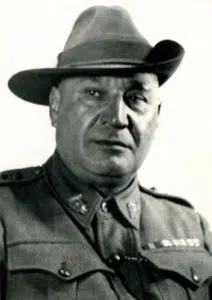
Captain Broughton. Photo: Harry Jay. Courtesy of the Jewish Museum of Australia.
dunera.de would like to thank author Bill Gammage, editor Seumas Spark, and publisher Sallie Butler for granting permission to reproduce Broughton’s biography from the book *Dunera Lives. Profiles*.

We would like to thank Suzanne Connell for providing photos from the estate of her great-uncle “Tip” Broughton.
