
Australia had addressed its severe labor shortage in early 1942 by, among other measures, conscripting 15,000 men into 36 labor companies. The 8th Australian Employment Company was one of eleven such units staffed by “aliens.” What made it unique: This unit consisted almost exclusively of Jewish refugees of German and Austrian origin who had been interned by the British in 1940 and deported to Australia on the HMT Dunera. These opponents of the Nazis were barred from military service; instead, they were assigned to heavy physical labor. It was certainly the largest Jewish unit in the Allied forces. Many soldiers were promoted to non-commissioned officers during their service.
Peter Dehn, June 2026
“Aliens” as non-commissioned officers
The Commanding Officer, Captain Edward Muhunga Renata Broughton and the first four lieutenants, as well as the first twelve Australian non-commissioned officers (NCOs) transferred to the 8th Australian Employment Company (8AEC), were remobilized veterans of World War I and of the appropriate age. Captain Broughton was apparently not entirely happy with these NCOs. He later noted[1] Quoted from Bill Gammage, “Edward Broughton: Soldier and Bookmaker,” in *Dunera Lives: Profiles* (Melbourne: 2020), ISBN 9781925835656, p. 10.:
„Half of them could not have lifted a paper-back and the other haqlf would have dropped it. Others would have been useless cleaning latrines and showers and would have been walking disasters in the kitchen. But they could all give orders, which no-one nobeyed anyway.“
Broughton soon realized that he was dealing with a highly educated unit in which everyone—despite some physical weaknesses—was prepared to fulfill their duty to the Allied cause at this critical juncture. As early as April 10, Broughton promoted[2] War diary, 1/2. ten soldiers to Lance Corporals, the lowest enlisted rank. No names were mentioned there. For this reason, it is unclear whether “aliens” were part of this group.
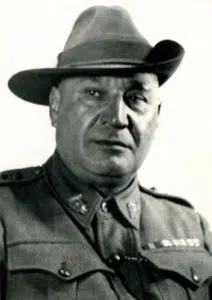
Captain Edward Broughton served as the unit’s C.O. from the formation of the 8AEC in April 1942 until May 1944. Photo: Harry Jay.
It was not until May 1942 that the names of those promoted began to appear in Broughton’s daily orders. Paul Allert, Bruno Friedländer, Bruno Kluger, and Alfred Lewinsky were the first former internees to be promoted to lance corporal[3] War diary, op. cit., 1/17, 1/75, 3/46. after just four weeks of service. On June 23, twelve more “aliens” were promoted, including Leon Gottlieb, Harry Jeidels and Franz Lebrecht. By the end of August, when the unit had been in existence for six months, another 27 “alien” soldiers[4] Kriegstagebuch, 1/75, 2/30 ff. were able to sew the first chevron onto their sleeves, identifying them as Lance Corporals.
Broughton’s approach to personnel management seems to have proven effective, “although one person said he had appointed musicians solely to spare their hands, and another believed that the non-commissioned officers of the ‘Dunera’ were more officious than the Australians[5] Dunera News 24, June 1992, p.8; Felix Werder to Ken Inglis 8/1/10; National Library of Australia (NLA), KS Inglis Dunera / Queen Mary Papers, Werder file..”

Lining up for roll call. From the estate of George Chodziesner. Courtesy of the Jewish Museum of Australia, Collection No. 135799.158.
The promotions do not readily confirm such favoritism. For example, the tenor Erich Liffmann was never promoted, even though he contributed significantly to the 8AEC’s reputation through concerts outside the unit and raised substantial donations for war bonds. Broughton did not necessarily require military experience for promotions. This was also not possible due to the age of most soldiers: only a few had served in Germany or Austria during World War I, including Sigurd Lohde. The oldest “foreign” NCO was born in 1882, the youngest in 1924, which corresponds to the age range of the internees and soldiers of the 8AEC. As the only Italian in the Queen Mary group, Alessandro Holper[6] Department of Veterans' Affairs Nominal Rolls, Entry for A. Holper. Accessed on May 25, 2026. was promoted and discharged as a sergeant in early 1947.
The NCOs’ duties included guard duty at the main camps in Melbourne. Initially, one lieutenant and two Australian NCOs were assigned to this task. Beginning in October 1942, an Australian NCO was often replaced by an “alien” NCO. Later, two “aliens” took over this duty. At the Albury base, guard duty was the responsibility of one “foreign” NCO and six soldiers (privates, or Pte for short).
About one in three “foreign” NCOs was discharged from the army by 1945. Another wave of discharges followed through the end of 1946. Some “foreign” NCOs served into the second half of 1947. However, only one of them was still listed in the 8th Employment Company at that time: Nine men had been transferred as interpreters to the 23rd Garrison Battalion[7] Virtual War Memorial Australia on 23 Garrison Battalion. Accessed May 25, 2026., which guarded Italian and German prisoners of war. They were stationed in Murchison (Victoria), near their former place of internment, Tatura. Eight men had volunteered for an Army malaria experiment.
Through appointments and promotions, the “foreign” NCOs of the 8AEC eventually filled the five lowest ranks of the Australian Army. Thus, one in every four to five privates was promoted to non-commissioned officer. Four men attained the highest rank of staff sergeant.
Broughton vs. Headquarters
It appears that not all of Broughton’s superiors viewed his personnel policy favorably. In a note pasted onto the official report form dated November 21, 1942[8] War diary loc.cit., 3/10. and signed by him, the captain states that he does not wish to be dictated to regarding his personnel policy:
„I have received verbal instructions from the D.A.D.L.[9] This is likely a department head responsible for logistics, infrastructure, training, administration, and the military police at the headquarters for the State of Victoria. H.Q. Vic L. of C. Area not to make any promotions until I am told to do so by him. For your information I wish to state that at least 75 % of these vacancies will be filled by personnel of this unit when I intend to promote to higher N.C.O. rank.“
The “alien” NCOs of the Eighth
The brief biographies of 124 “foreign” NCOs reflect the diverse composition of the 8th Australian Employment Company. In addition to their final rank and name, their length of service is listed. The information is based primarily on digitized personnel files from the National Archives of Australia (NAA) and the Department of Veterans’ Affairs (DVA), as well as the unit’s war diary. In some cases, documents from the genealogy platform Ancestry were also consulted. Although the present war diary ends on January 31, 1946, it is known that many soldiers and non-commissioned officers remained on the 8AEC’s roster until the second half of 1946. Where no religion is noted, the men in question are Jewish. Men who were (like Jeidels) demoted to private for unknown reasons are not included here.
Lance Corporal Siegbert Abramczyk (April 8, 1942 – March 14, 1946)
Born in Wreschen (Poland) in 1904, the bookkeeper was initially detained by the British at Kempton Park Camp; after a period of internment and military service in Australia, he became a naturalized citizen on September 30, 1946.
Lance Sergeant Paul Allert (April 24, 1942 – March 5, 1946)
He was born in Vienna in 1907, where he studied law. In England, he was training to be a carpenter. He was naturalized on July 19, 1945, but died in November of that same year.
Sergeant Günther Altmann (April 8, 1942 – January 15, 1946)
Born in 1918 in Düsseldorf, Protestant, farmer. He was assigned to the 23rd Garrison Battalion in May 1944 and likely went to Brazil to join his father in 1947.
Sergeant Werner Baer (April 8, 1942 – November 26, 1945)
Born in Berlin in 1914, he was a musician at a synagogue. After Kristallnacht, he was imprisoned as an “Aktionsjude” at the Sachsenhausen concentration camp before he was able to flee with his family to Singapore at the end of 1938. From there, he was deported by the British to Australia aboard the Queen Mary in mid-September. He was a musician and music teacher and participated in the unit’s cultural activities. Part of the satirical revue “Sergeant Snow White” was his composition “Sounds of Europe” (lyrics by Simon Hochberger, performed by Sigurd Lohde), which won an award in an Army song contest[10] See the short biography of Werner Felix Baer in Albrecht Dümling, *The Vanished Musicians* (Oxford, 2016), ISBN 9783034319515., p. 487.. The family was naturalized in May 1946.
Lance Corporal Emil Beck (April 26, 1942 – June 9, 1944)
Born in Vienna in 1898, he was a poultry farmer. He had served in the Austrian Army from 1914 to 1916. He was discharged from the Australian Army after a prolonged illness. He became an Australian citizen on August 25, 1945.
Lance Corporal Gerhard Johannes Biermann (February 22, 1944 – January 18, 1946)
A Protestant, he was born in Argentina in 1900 and interned by the British as a sailor on the blockade-breaker Gonzenheim. Consequently, he was initially treated as a prisoner of war at the Tatura camp. He was only able to enlist in the army late in the war, after his status had been changed.
Lance Corporal Kurt Blach (April 8, 1942 – November 26, 1945)
The musician was born in Rinteln in 1908. A job took him to Singapore, where he was forced to remain after the war began. He and his wife were part of the Queen Mary group. Both were naturalized in May 1946.
Lance Corporal Hans Blau (September 18, 1942 – September 25, 1945)
Born in Vienna in 1906. Another musician who had been brought to Singapore for a gig and who, along with his wife, was deported from there to Australia on the Queen Mary. The couple became Australian citizens in August 1946.
Sergeant Erich Blitz (April 8, 1942 – October 30, 1945)
The salesman, born in Vienna in 1902, and his brother had likely been housed in the Kitchener Camp transit camp in England (in the same hut as Heinz Dehn) and had traveled on to Singapore, from where both were transported to Australia on the Queen Mary. Erich was naturalized in September 1945.
Sergeant Walter Blitz (April 8, 1942 – February 1, 1946)
Erich’s older brother was born in 1898 and followed the same path as Erich to Australia. During World War I, he had served in the Austro-Hungarian Army. He, too, was naturalized in September 1945.
Corporal Gerd Adolf Blumenfeld (April 24, 1942 – July 4, 1946)
Born in Breslau in 1920, he was trained as an engineer. He was one of the internees who worked as fruit pickers from early 1942 until he enlisted in the Australian Army.
Lance Corporal Moriz Chlumecky (August 31, 1942 – June 22, 1944)
The Catholic stamp dealer was born in Brno in 1882. The comparatively early discharge of the oldest “alien” NCO was due to health reasons.
Lance Corporal Rolf Bernd Daltrop (April 8, 1942 – April 11, 1946)
Born in Harburg in 1914, the engineer and technical draftsman was arrested near Birmingham. He was naturalized in Australia in July 1946.
Sergeant Felix Danzig (April 8, 1942 – December 24, 1945)
Born in Vienna in 1891, he had worked as a hotel manager in Singapore before the British deported him, along with his wife and daughter, to Australia. During World War I, he had commanded an Austrian machine-gun company. The family was naturalized in August 1947.
Lance Corporal Hans Davidson (June 2, 1942 – February 15, 1945)
The film producer from Frankfurt am Main was born in 1905. He was half-Jewish. Upon his discharge from the army to a civilian occupation, he became an Australian citizen.
Lance Corporal Alfred Deutsch (August 14, 1942 – February 5, 1944)
The teacher was born in Vienna in 1898. He had served in the Austrian Army from 1916 to 1920. In England, he had worked as a private tutor. He was discharged from the 8AEC as “medically unfit.”
Lance Corporal Harold (Harry) Leo Diamand aka Diamond (April 8, 1942 – January 11, 1946)
He was born in Vienna on 15 November 1922, the son of Karl Diamand and Saly Feiner. He had apparently begun studying engineering before fleeing, but whilst in exile in Britain he was forced to work in a leather factory in Staffordshire. At the age of 19, he joined the 8th Employment Company. Immediately after his discharge on 11 January 1946, he was able – together with more than 50 former internees, most of whom had also served in the army – to travel to Southampton aboard the Athlone Castle.
Corporal Kurt Dornberg (April 8, 1942 – November 27, 1945)
Born in Berlin in 1906, he had become a merchant. He and his wife came to Australia via Singapore. They were naturalized in 1946.
Corporal Ludwig Edelstein (April 8, 1942 – February 14, 1946)
The merchant was born in 1899 in Sugenheim (Bavaria). He was forced to flee, was interned by the British on the Isle of Man, and deported to Australia on the Dunera.
Staff Sergeant Erwin Friedrich Alfred Fabian (April 8, 1942 – June 24, 1946)
Born in Berlin in 1915, he described himself in Australia as a commercial artist; after the war, he also worked as a sculptor, painter, and industrial designer. He created several works during the Dunera’s voyage and while interned in Hay, Tatura, and Orange. After the war, he initially lived in Great Britain but later became an Australian citizen and moved to Melbourne.
Corporal Adolf Felder (April 8, 1942 – November 26, 1945)
Born in Frankfurt am Main in 1914, he was a leather expert. In October 1946, he and his wife became Australian citizens.
Lance Corporal Henry aka Hansheinz Felder (April 8, 1942 – February 12, 1946)
Adolf’s brother was born in 1922, also in Frankfurt am Main, and was a knitting machine operator. He, too, married while serving in the army and was naturalized in July 1946.
Sergeant Hans Fischer (aka Fisher) (April 8, 1942 – December 4, 1945)
The merchant and accountant from Vienna, born in 1905, had managed to escape the Nazis to Singapore. From there, the British, under false pretenses, sent him to an internment camp in Australia. In August 1946, he and his wife became Australian citizens.
Corporal Gert Flatau (April 8, 1942 – October 1, 1946)
Born in Berlin in 1923, he was studying in London when he was arrested on July 1, 1940, and then deported on the Dunera. In October 1945, he was accepted into the Malaria Experiment, of which he remained a member until his release. He stayed in Australia, became a physicist, and started a family.
Lance Corporal Oskar Fleischer, aka Oscar Harold Fletcher (April 8, 1942 – November 26, 1945)
The musician, originally from Vienna (*1910), arrived in Australia on the Queen Mary. He was the bugler[11] Bern Brent in Dunera News No.27, p. 17. with the 8AEC. He married in 1943 and became the father of twin girls. The family became Australian citizens in August 1946; they eventually ran a poultry farm.
Corporal Bruno Ernst Friedländer (April 8, 1942 – May 23, 1944)
The technician was born in Vienna in 1899 and was forced to flee because of his origins. He was one of the first “aliens” in the unit to be promoted to non-commissioned officer. After being discharged from military service as “medically unfit,” he remained in Australia and was naturalized in May 1946.
Lance Corporal Arthur Fuhrmann[12] Listed in the military records as a “Furhmann”; see NAA_ItemNumber6255280. (April 8, 1942 – August 21, 1943)
Born in Vienna in 1910, the clerk had been brought to Australia via Singapore with his wife. His internment ended with his assignment as a fruit picker. His early discharge from the army followed a prolonged hospital stay.
Corporal Salomon Glueck (April 8, 1942 – June 30, 1945)
The Polish forestry engineer was born in 1907 in Lisko Lukawyica (Poland). He was interned in Australia along with his brother, sister, and brother-in-law, after arriving from Singapore.
Corporal Hugo Gottlieb (April 7, 1942 – January 14, 1946)
The merchant from Vienna, born in 1894, was drafted into the Austrian Army during World War I. After serving in the Australian Army, he went to England.
Lance Corporal Leon Gottlieb (April 7, 1942 – November 4, 1942)
You can read a detailed biography here, as well as his account of his experiences in Nazi concentration camps [https://dunera.de/zwei-jahre-in-nazi-kzs/].
Sergeant Otto Gottlieb (April 8, 1942 – November 28, 1946)
Otto Gottlieb, a civil engineer from Wörgl (Austria) born in 1907, was also imprisoned in Dachau before he was able to escape with his family to Singapore, where he was interned. In February 1945, he was transferred to the 23rd Garrison Battalion as an interpreter for prisoners of war. He was naturalized in 1946.
Lance Corporal Horst Otto Robert Graffunder (November 30, 1943 – September 18, 1946)
The Catholic and historian was born in Elling (Bavaria) in 1906. In London, he was classified as a Nazi (Category “A”) by the MI5 intelligence service. His application to the British Pioneer Corps[13] „List 6 - Particulars of U.K. Internees (interned in Australia) who desired to enlist in the pioneer corps of the British army“ in NAA_ItemNumber216015, p. 182. was possibly rejected for this reason. He was transferred from Tatura to Loveday in early September 1942 and enlisted in the army very late. He was naturalized in 1946.
Sergeant Fritz Henry (Heinz) Georg Grün (April 8, 1942 – February 14, 1946)
Born in Vienna in 1921. He was a lithographer by trade. He was arrested in Manchester and deported to Australia. In the Australian Army, he was transferred to the Army Education Service in Queensland in June 1945 following a prolonged illness. Shortly thereafter, he became an Australian citizen.
Corporal Kurt Gruenbaum aka Ken Green (September 3, 1943 – December 2, 1946)
Born in Erfurt in 1921, he was a cook. The British listed him under the Nazi-era surname “Israel”; nevertheless, they treated him as an enemy and deported him to Australia. Naturalized in July 1946, he anglicized his name and married an Australian woman.
Corporal Ludwig Gruenbaum (April 8, 1942 – November 30, 1945)
The merchant was born in 1903 in Kuppenheim (Baden). He was taken from Singapore to the Australian internment camp with his wife and daughter. Before joining the army, he worked as a fruit picker. In October 1943, army doctors diagnosed him with the thyroid disorder thyrotoxicosis. In August 1946, the family was naturalized.
Corporal Werner Haarburger (April 8, 1942 – April 10, 1946)
The merchant was born in Düsseldorf in 1922. After his escape, the British interned him in Kempton Park before deporting him and his older brother Walter to Australia. Following his internment, he joined the “fruitpickers.” He was transferred to the 23rd Garrison Battalion in Murchison in October 1944. The brothers became Australian citizens in September 1946.
Lance Corporal Berthold Halpern (April 8, 1942 – September 18, 1946)
Born in Vienna in 1923, he was living in England as an engineering student when he was arrested and then deported. During his service, he spent two months in the hospital in late 1944. He was naturalized in 1947 and lived in New South Wales.
Lance Corporal Heinz Robert Herrmannsohn, aka Henry Henderson (April 8, 1942 – November 14, 1945)
He was born in 1921 in Stettin, listed his occupation as electrician, and lived in Berlin before fleeing. During his service, he anglicized his name, married, and was naturalized.
Sergeant Allessandro Holper (April 8, 1942 – February 3, 1947)
He was an Italian born in Russia in 1919 and was a medical student when the British deported him and his family from Singapore and interned them in Australia. Although they had most recently lived in Milan, they were classified as Russian Jews in Australia. In April 1944, he was transferred to the 23rd Garrison Battalion as an interpreter; at the end of his service, he was formally listed in the 13th Aus PW Group. His father Raffaele, born in Riga in 1889, also served in the 8AEC. The family was naturalized in 1946.
Sergeant Hans Holzbauer aka John Wood (April 8, 1942 – March 28, 1946)
The musician was born in Vienna in 1909. In 1938, he accepted an engagement in Singapore and was brought from there to Australia on the Queen Mary. After the army, he remained in Melbourne, performing as a musician, but held a primary job in the civil service[14] Albrecht Dümling, *The Vanished Musicians*, Cologne 2011, ISBN 978-3-612-20666-6, p. 504..
Lance Corporal Julius Homburg (April 26, 1942 – April 28, 1944)
Born in Offenbach on Main in 1888, this leather cutter had served in the German army during World War I. In Australia, he was discharged from the army at age 56 for health reasons. He became an Australian citizen in December 1946.
Lance Corporal Horst Jacobinski, aka Jacobs (April 26, 1942 – February 15, 1946)
Born in Stuttgart in 1922, the dental technician was arrested in Manchester in late June 1940 and deported on the Dunera. He had married an Australian woman, and they were naturalized in Brisbane in 1946. Horst Jacobs was the founding president of what was then the Hay Tatura Association, now the Dunera & Queen Mary Association.
Lance Sergeant Otto (Jack) Jacobs (April 8, 1942 – April 26, 1946)
He was born in 1914 into a farming family in Sögel near Bremen. Until December 20, 1938, he was imprisoned at the Sachsenhausen concentration camp—apparently as an “Aktionsjude” (a Jew targeted for deportation). The British interned and deported him. After his internment ended, he was assigned to work as a fruit picker before enlisting in the army. He was naturalized in November 1945.
Lance Corporal Gerhard Kaczynski (July 29, 1942 – May 27, 1946)
The refugee from Berlin (*1920) worked as a farm laborer in England. Even before his service ended, he applied for a permanent residence permit in 1945. The application bears the stamp “Naturalization granted” dated October 24, 1950.

Soldiers of the 8th Employment Company in Albury in 1942. Courtesy of the Jewish Museum of Australia, Collection No. 4149.
Lance Corporal Gerhard Kadden (April 8, 1942 – August 14, 1946)
Despite his youth (born in 1921 in Herford), he was admitted to the Dachau concentration camp (No. 29637) on November 17, 1938. As with the other “Aktionsjudeb,” his release on January 12, 1939, was conditional on his immediate departure from Germany. The same fate befell his twin brother Rainer (29644); their father Moritz was also imprisoned. The sons escaped to England on a Kindertransport[15] See records in the Arolsen Archives, under “Mapping the Lives” and on Ancestry. Stumbling Stgones for the Kadden family in Essen. Accessed May 19, 2026.. Rainer was deported to Canada, Gerhard to Australia. Shortly after his military service, Gerd was naturalized.
Corporal Julian Kadisch (April 24, 1942 – November 29, 1946)
The merchant was born in 1904 in Dirschau (West Prussia). During his internment in Hay, he was housed in Hut 18 together with Heinz Dehn; they may have already known each other from Kitchener Camp. In June 1946, while still in service, he became an Australian citizen.
Lance Corporal Paul Frank Kaemmerer (April 26, 1942 – October 20, 1943)
A Catholic born in 1896 in Gowidlino (West Prussia), he was a painter. During World War I, he served as a lieutenant in the artillery. He was discharged from the Australian Army after 18 months as “medically unfit.” He was naturalized. In 1955, he filed a utility model for a design of light bulb sockets for registration.
Lance Corporal Kurt Kaminski (December 9, 1943 – January 10, 1946)
The Protestant was born in Berlin in 1901 (in Australia, 1900 was given as his year of birth). He was a tractor driver. He served in World War I in 1917–18. The Nazis imprisoned him at the Sachsenhausen concentration camp[16] Mapping the Lives. Accessed on May 19, 2026 from June 21, 1938, to March 29, 1939. Although he was known to British authorities as a victim of Nazi persecution due to the forced first name “Israel,” he was classified as a Nazi (Category “A”) and deported. He was one of the survivors of the sinking of the Arandora Star. He was not released from internment until 1943 and was only able to enlist in the army afterward. After his release, he remained in Australia.
Lance Corporal Albert Ferdinand Karolyi (April 8, 1942 – June 24, 1946)
A Catholic, he was born in Vienna in 1920. At the time of his arrest, he was a physics student in Nottingham. He was among the internees who worked as fruit pickers starting in February 1942. While serving in the Australian Army, he was naturalized in January 1946, but applied for U.S. citizenship in 1968.
Lance Sergeant Alfred Felix Katz (April 8, 1942 – September 5, 1945)
He was born in 1923 in Witten (Ruhr region) and trained as an upholsterer. After deportation, internment, and military service, he became an Australian citizen in July 1946.
Corporal Ernst (Ernest) Katz (April 8, 1942 – March 28, 1946)
The handbag designer was born in 1918 in Hamborn (Ruhr region). He was naturalized in Australia in October 1946 but moved to the United States in 1947.
Lance Sergeant Manfred Katz aka Catts (April 8, 1942 – March 12, 1946)
Born in 1910 in Tuchel (West Prussia), the farmer was housed in the Kitchener (transit) camp in England, where he was interned. He married in 1938 and brought his wife Liesel from Argentina to Australia, where both were naturalized in July 1946 and later anglicized their surname. While in the army, he had, among other things, earned a qualification as a typewriter mechanic.
Lance Corporal Georg Eduard Justus Hugo Kaufmann (May 29, 1944 – January 6, 1947)
The corset maker and weaver was born in Düsseldorf in 1921. He was released from internment in March 1942 “on probation” and settled in Melbourne. He did not enlist in the army until late May 1944. He was naturalized in May 1946.
Lance Corporal Paul Kaufmann (April 8, 1942 – February 18, 1946) – The Catholic refugee, born in 1922, was from Vienna. He listed his occupation as a student of agricultural sciences. In October 1946, he became an Australian citizen.
Corporal Bruno Kluger (April 8, 1942 – December 16, 1944)
He was born in Munich in 1905. He listed his occupation as designer and sales representative. He was one of the first “foreign” soldiers to be promoted. He and his wife, whom he had brought over from New York, were naturalized in October 1946.
Sergeant Erich Maximilian Knopf, aka Eric Maximilian Knox (April 8, 1942 – November 27, 1945)
The Protestant bookbinder from Munich, born in 1898, had served in the German Army for two years during World War I. He had traveled to Australia via Singapore on the Queen Mary. He and his wife were naturalized in July 1946.
Lance Corporal Heinz Martin Königsberger (August 31, 1942 – December 12, 1945)
The tobacco export merchant was born in 1909 in Katowice (Silesia) and was arrested by the British at Kitchener Camp. He injured his foot in a work-related accident at the 8AEC in Albury. He brought his wife from Breslau to Australia; they were naturalized in June 1946.
Lance Sergeant Leopold Kohn aka James Leopold King (April 8, 1942 – September 2, 1946)
The Catholic baker was born in Vienna in 1923. After internment and military service, he became an Australian citizen.
Corporal Fritz Korn, aka Frank Pennells (April 8, 1942 – August 27, 1946)
He was born in Vienna in 1921 and wanted to become a bookseller. The British classified him as a Nazi sympathizer in Category “B.” He was training to be a nurse, had unsuccessfully enlisted in the British Army, and was interned at Kempton Park Camp. In Australia, he listed his occupation as farm laborer. After learning that his brother and sister had survived, he wanted to be repatriated. This did not happen; he married in 1946 and was naturalized in Australia in 1949.
Corporal Heinz Kossmann (April 8, 1942 – January 10, 1946)
He was born in Cologne in 1911 and worked there as a merchant. The British interned him, along with many others whom they themselves had classified as refugees in Category “C.” In Australia, he listed his occupation as a textile machine mechanic and driver. He returned to England in February 1946 after completing his military service.
Corporal Willi (Wilhelm Wolfgang) Lampl (April 8, 1942 – April 16, 1946)
He was born in Vienna in 1915 and listed his occupation as a milk inspector or chemist specializing in dairy products, and his religion as the Church of England. In the Australian Army, he completed a driver’s training course with an excellent evaluation. He married in early 1946 and was naturalized that same year. However, his military file[17] Military file of W.W. Lampl, NAA_ItemNumber6633480, pages 9–10. also reveals how many “alien” soldiers were treated: In 1949, he had applied for a loan as part of the postwar reconstruction effort. The relevant bureaucracy asked the Army whether he was classified there as a “friendly or enemy alien.” The army replied that he had been drafted as a friendly alien.
Lance Corporal Franz Lebrecht (April 8, 1942 – February 12, 1946)
You can read the detailed biography of the Queen Mary deportee here.
Lance Corporal Kurt Leiser (April 8, 1942 – August 12, 1945)
Born in Cologne in 1921, this welder and moulder was interned at the British transit camp Kitchener Camp. He was discharged from the army to take up employment at a metalworking company in Melbourne. He was naturalized in September 1946.
Corporal Alfred Lewinsky (April 8, 1942 – December 12, 1945)
Born in Berlin in 1917, the leather goods specialist and designer and his wife, whom he had married in 1943, became Australian citizens in December 1945.
Lance Corporal Manfred Lindner (April 8, 1942 – July 17, 1946)
The timber merchant was born in Heilbronn in 1920. His naturalization, granted in 1946, was revoked because he moved to England and acquired British citizenship in 1955.

“Off Duty” is the caption for the photo taken in late 1942 at a party in Lance Sergeant Ernst Zutrauen’s apartment. Back row: Carl Solmitz, Lance Sergeant Max Meth, Corporal Alfred Lewinski, unknown, Sergeant Edward Nelken, Fritz Schönbach, Lance Corporal Stefan Weinberg, Paul Altmann (?), Walter Fürst, unknown. 2nd row: unknown, Simon Hochberger, Klaus Friedeberger, Martin Reichwald, Hans Stocky. 3rd row: Sergeant Kurt Sternberg, Lance Corporal Georg Kaufmann, unknown woman, Lance Sergeant Ernst Zutrauen, Lance Corporal Ernst Schoenfeld, Walter Weyl. 4th row: unknown, Kurt Rothfels, Corporal Franz Lebrecht, Sergeant Walter Emden (all from left). Reproduction from Dunera News No. 43, page 9. Note: The names were taken from the publication cited; first names were added. However, the names “Freiberger” (correct: Friedeberger) and “Herrnstadt” (correct: Lebrecht) listed there are based on errors. The last ranks were added.
Lance Corporal Bruno Arthur Lipmann (April 8, 1942 – October 20, 1943)
Born in Vienna in 1918, this Protestant export merchant was discharged very early on to take a job with the Australian broadcaster ABC. He and his wife were naturalized in August 1945.
Lance Corporal Erich Lipmann (April 8, 1942 – August 21, 1945)
His brother, born in 1917 and a sales representative by profession, did not find a civilian job until nearly two years later. He had been naturalized in February 1945.
Sergeant Sigurd Sigismund Lohde (April 8, 1942 – August 30, 1945)
You can read a detailed biography of the Berlin actor here.
Sergeant Ludwig Maas (June 11, 1942 – April 2, 1947)
Born in Diez an der Lahn in 1891, he served as a military driver during World War I. The British had classified him as a suspected Nazi (Category “B”). Despite their Jewish heritage, he and his wife were interned in various camps on the Isle of Man. In Australia, after several hospital stays, he was transferred as a soldier to the 23rd Garrison Battalion in Murchison in April 1944. He was naturalized in August 1946. He died on December 22, 1948, “as a result of a war-related illness[18] Obituary posted by his wife, via Ancestry.”.
Lance Corporal Hans Joachim Margis (July 16, 1944 – December 9, 1946)
The merchant and Protestant, born in 1916 in Berlin, was a survivor of the Arandora Star. The British intelligence service MI5 had classified him as a Nazi (category “A”). This prejudiced misinformation was eventually cleared up, so that he was not allowed to join the Australian Army until 1944. He was naturalized in April 1947. His mother supported the communist resistance in Germany.
Corporal Franz (Frank) Massarik (April 7, 1942 – April 1, 1946)
He was born in 1911 in Zwittau (now in the Czech Republic) and was arrested by the British at Kitchener Camp. Heinz Dehn had also been there; they met again at the Hay internment camp, Barracks 18, and then in the army. Thanks to his training as a surveyor, he was transferred to a surveying unit in October 1942 and to the 2/1 Aust Army Topographical Survey Company in May 1943, where he completed his service in April, 1946. He and his wife, who had come from the U.S., were naturalized in September 1946.
Corporal Leo Max (April 7, 1942 – November 2, 1945)
The tailor from Kobersdorf (Austria) was born in 1910. The British interned him in Lingfield. After his internment, he was initially employed as a fruit picker. He married in 1943 and was naturalized in 1945.
Lance Corporal Gerd May (April 8, 1942 – August 21, 1946)
The warehouse manager from Frankfurt am Main, born in 1923, had completed an apprenticeship at a leather goods factory in England prior to his internment. The British also listed him under the additional name “Israel,” so that he was known as a victim of Nazi persecution. He was one of the youngest soldiers in the 8AEC.
Lance Corporal Otto Martin Mayer (April 8, 1942 – November 23, 1945)
The sales representative was born in Bremen in 1913. He was interned by the British at Kempton Park camp. In August 1945, he married; he was discharged from the army in November, and the couple became Australian citizens in January 1946.
Lance Corporal Bertold Meier, aka Bertold Irving Myer (July 4, 1942 – December 11, 1945)
The window dresser and sign painter from Mühlheim/Ruhr, born in 1911, was interned and deported by the British—despite being classified as a refugee (Category “C”) and even though he was known to the authorities as a Jew. He and Heinz Dehn were housed in Barracks 18 in Hay. He changed his name in mid-1944 and married in June 1945. He was naturalized in July 1946.
Lance Sergeant Max Ludwig Meth (April 8, 1942 – February 5, 1946)
He worked in Dresden as a shirt cutter, where he was born in 1918. He was naturalized in Australia in November 1945. His younger brother Rudolf was also a Dunera Boy and briefly served as a soldier in the Eighth.
Lance Corporal Joseph Millet (April 8, 1942 – September 20, 1946)
Born in Vienna in 1924, he was one of the youngest Dunera Boys. The British arrested him while he was working as a hotel porter in London. After his internment ended, he initially worked as a fruit picker before joining the army. He married in 1944 and was naturalized shortly before the end of his military service.
Lance Corporal Robert Francis Lewis (Louis) Mugdan (April 8, 1942 – February 18, 1946)
A Protestant born in Munich in 1922, he worked as a farm laborer in England before being interned. In Australia, he stated that his career goal after his military service was to study architecture. He married in July 1945. A year later, both were naturalized.
Corporal George Hans Nadel (April 8, 1942 – September 28, 1945)
He was born in Vienna in 1921. He escaped to England on a Kindertransport in early 1939. His internment brought his schooling to an end. He was one of the prisoners whom the Dunera’s guards forced to walk over broken glass[19] Jennifer Nadel "In search of my father", Inside Story, October 10, 2025. Accessed June 10, 2026.. After his internment ended, he worked as a fruit picker in Australia. In December 1942, he was transferred from the 8th to the 27th Employment Company, and in March 1943 to the 4th Ordnance Stores. After his request for a transfer to the Air Force was denied, he served there until the end of his tour of duty. He became an Australian citizen in July 1946. He graduated with first class honors in 1948. His subsequent application to the Air Force’s historical department was rated “entirely suitable” following an extensive security check[20] Security clearance files for George Hans Nadel, NAA_ItemNumber6254964.. University representatives also noted his involvement in various campus clubs. He later moved to England and started a family.
Sergeant Edward Nelken aka Edward George Nelson (April 7, 1942 – November 29, 1945)
He was born in Berlin in 1920 and worked as a clerk. He was forced to leave Germany due to racial persecution. He completed his military service in the 1st Aust Base Sub Area. His Australian citizenship, granted in May 1945, was revoked after he became a U.S. citizen in 1952. He had already moved to New York in 1946.
Lance Sergeant Karl Heinz Nerichow (April 8, 1942 – August 28, 1946)
The carpenter was born in Dortmund in 1921. While in exile in Britain, he worked as a farm laborer. He was naturalized around the same time he was discharged from the army. In 1947, he brought his sister from England to Australia.
Corporal Alfred Oberländer aka Oberlander (April 8, 1942 – January 17, 1945)
Born in Vienna in 1898, he worked as a journalist. The British interned him at Kempton Park. After his internment, he worked briefly as a fruit picker in Australia before volunteering for the army. In May 1944, he was transferred to the 23rd Garrison Battalion as an interpreter. After his service, he returned to Great Britain, where he became a naturalized citizen in 1950.
Corporal Hans Max Oppenheimer (April 8, 1942 – March 21, 1946)
‚Born in Bad Ems in 1912, the truck driver became a farm worker while in exile in Britain. Upon his discharge from the Australian Army, he was expressly certified as a “Refugee Alien[21] Military file of H.M. Oppenheimer, NAA_ItemNumber6257277, p. 6.”. He brought his wife from the U.S. to Australia; both became Australian citizens in August 1946.
Lance Corporal Heinz Friedrich (Frederick) Oschinsky (April 24, 1942 – March 29, 1946)
He was born in 1908 in Breslau (Upper Silesia). After serving in the Australian Army, the trained shoemaker settled in a suburb of Sydney, where he established a business manufacturing boots and shoes. He was naturalized in August 1948.
Corporal Adolf Pauson (April 8, 1942 – November 29, 1945)
The agricultural merchant was born in Göttingen in 1908. During “Kristallnacht,” his family was arrested. While his wife and the three-year-old son were released the following day, he remained in custody[22] Memorial book Göttingen. Accessed May 25, 2026.. At the end of August 1939, he fled to England and the Kitchener Camp transit camp. The British arrested him there in May 1940. He applied to bring his wife and son to Australia, but later moved to join them in the United States.
Corporal Karl Alexander Pollak (April 8, 1942 – January 11, 1946)
A Catholic merchant, born in Leipzig in 1911. After completing his military service, he traveled to England immediately in 1946.
Lance Corporal Walter Karl Pollak (April 24, 1942 – August 20, 1946)
He was born in Vienna in 1920. He had to give up his profession as a civil engineer while in exile and became a farmer. In 1944, he renounced Judaism. In November 1946, he became an Australian citizen.
Lance Corporal Heinrich Portnoj (May 21, 1942 – November 26, 1945)
The professional musician, born in Vienna in 1895, worked as a music teacher in Singapore after fleeing until he was deported to Australia on the Queen Mary. After his discharge from the army, he demanded compensation for the “30-day rehabilitation leave” to which he was entitled but which had not been granted. He and his wife were naturalized in May 1946; the processing of the application filed in early 1945 was fraught with red tape: his wife’s application was to be processed only after a year or upon a separate application[23] Personnel files of Heinrich and Annie Portnoj, NAA_ItemNumber7026171, NAA_ItemNumber769186..
Lance Corporal Jobst Radok (May 13, 1942 – February 5, 1946)
The middle of the three Radok brothers from Königsberg who survived the sinking of the Arandora Star was born in 1917 and worked as an export salesman. British intelligence classified him as a Nazi (Category “A”). During his time in the army, he qualified as a Unit Education Officer. All three brothers served and were naturalized.
Lance Corporal Hans Reichenberger, aka Howard Vincent Rickenberg, (April 8, 1942 – August 8, 1946)
The law clerk was born in Nuremberg in 1922. After serving in the Australian Army, he moved to the U.S.; in Indiana, he was a professor of bacteriology.
Lance Corporal Carl (Karl) Reither (September 18, 1942 – December 11, 1945)
Born in 1907 in Kassa (Hungary), this Catholic Austrian came to Singapore as a professional musician. He was deported on the Queen Mary along with his wife and child. A second son was born in the Tatura internment camp. According to the Tatura commander, Major Sproat, he described himself as “pro-Nazi,” and his political views were “highly questionable.” In late 1941, he requested to be transferred to a compound without Jews. “ “…if his request to be transferred was on account of hating the Jews, I consider it would not be against the interests of security if he were permitted to enlist in a Labor Unit,” Sproat commented. The “Investigation Board[24] Memoranda, etc., by James Sproat, “Ex Commandant,” No. 3 Internment Camp, Tatura, and other references in the security clearance file of Carl Reither. NAA_ItemNumber780460, pages 15, 19, 25, 28.” concurred with this recommendation. He was naturalized in January 1946.
Lance Corporal Hans Karl Ruppin (September 18, 1942 – March 26, 1947)
The Presbyterian merchant was born in Hamburg in 1913. He married in August 1943 and was last listed in the Australian Army at the 115 Heidelberg Military Hospital. He and his wife were naturalized in November 1945.
Lance Corporal Leib Sauerstrom (April 26, 1942 – August 14, 1944)
Born in 1899, this farmer from Wielkie (Poland) was able to emigrate to Kitchener Camp. Although he had been diagnosed with bronchitis, the British interned him and deported[25] Personnel file of the Jewish Refugee Committee, London, in NAA_ItemNumber769209, page 9. him to Australia on the Dunera.
Corporal Karl Peter Alfred Schmitz (April 8, 1942 – May 29, 1944)
A Catholic and professional ballet dancer, he was born in Berlin in 1918. He was discharged from the Australian Army for health reasons. In August 1946, he became an Australian citizen.
Lance Corporal Ernst (Ernest) Adolf Schoenfeld (April 8, 1942 – August 21, 1946)
The salesman was born in Vienna in 1921. He returned there after his military service.
Staff Sergeant Herbert Schwarz (February 12, 1943 – July 16, 1946)
Born in Vienna in 1913, the stonemason was interned at the Kitchener Camp transit camp in May 1940. He enlisted late in the 8AEC. In June 1946, he was naturalized in Australia.
Corporal Nils Paul Schwerke (February 5, 1944 – January 10, 1946)
Born in 1911 in Weissstein (Silesia), the film producer and Protestant was arrested in London as early as December 1939. He survived deportation on the Arandora Star. He decided very late to volunteer for the army. Immediately after his discharge, he traveled to England with a group of former soldiers from the 8AEC and from there to the U.S. in 1947, where relatives lived.
Corporal Gerhard Seefeld (January 25, 1943 – July 1, 1946)
The Protestant merchant with Jewish roots from Hamburg (*1905) had been deported from Singapore along with three generations of his family. He was known among the German-speaking Queen Mary internees as a staunch advocate for their interests—primarily regarding their demand for the separation of persecuted individuals and Nazis at the Tatura internment camp. Consequently, the camp commander dismissed him for insubordination, which did nothing to defuse the conflict. Gerhard had not enlisted in the army until early 1943. He and his family were naturalized as early as January 1945.
Corporal Helmut Seefeld (April 8, 1942 – October 25, 1944)
Gerhard’s younger brother was born in 1913 in Dockenhuden (Hamburg) and was also a merchant. He was discharged early from the army for medical reasons. He and his wife were naturalized in February 1946.
Corporal Alfred Simenauer (April 8, 1942 – March 25, 1946)
Born in Düsseldorf in 1920, he was a pastry chef. He was interned by the British as an “enemy alien” and deported to Australia along with his brother Kurt. In May 1944, he was transferred to the 23rd Garrison Battalion (guard duty for prisoners of war). Shortly before his discharge, he was punished for refusing to censor letters from the prisoners.
Corporal Kurt Simenauer (April 8, 1942 – June 12, 1946)
Alfred’s younger brother was born in Düsseldorf in 1921 and listed cabinetmaker as his occupation. In August 1944, he too was transferred to the 23rd Garrison Battalion as an interpreter. After his military service, he went to the United States.
Sergeant Ernst (Ernest) Ludwig Simon (April 8, 1942 – February 11, 1946)
The export merchant was born in Bingen am Rhein in 1901. During the voyage of the Dunera, he and other internees assisted the British army doctor Brooks. He became an Australian citizen in November 1945.
Sergeant Friedrich (Fred) Skaller (April 8, 1942 – June 12, 1946)
This Protestant, a vocational instructor for agricultural professions by trade, was born in Görlitz in 1904. His service in the Australian Army also led him to the 23rd Garrison Battalion, where he served for more than two years starting in March 1944. His naturalization, along with that of his wife, who had come to Australia from exile in Switzerland, was approved in December 1946.
Lance Sergeant Philip Walter Skrein (April 8, 1942 – July 3, 1946)
The Catholic from Vienna was born in 1918 and worked there as a commercial clerk. When and why he went to Singapore is unknown. There, among other things, he served voluntarily in the Royal Engineers Corps for a year before being deported to Australia on the Queen Mary. Shortly after his discharge from the Australian Army, he was naturalized in August 1946.
Corporal Franz Ferdinand Leopold Stampfl (April 8, 1942 – January 11, 1946)
This Catholic and coach, born in Vienna in 1913, coached Austria’s Olympic track and field athletes in 1936. He fled to England in 1937. The British census recorded him in a prison in Liverpool in September 1939. Despite being classified in Category “C,” he was deported to Australia. He was involved in athletic activities at the Tatura and Hay camps. After his military service, he went to England and worked again as a coach. He is considered the inventor of interval training and the man behind the scenes in breaking the 4-minute mile barrier. World record holders and Olympic champions emerged from his school. Later, he coached Australian runners in Melbourne and became a naturalized citizen in 1956. He received numerous international awards but was hardly known in his country of origin.
Sergeant Kurt Sternberg (April 8, 1942 – February 19, 1945)
The film producer was born in 1899 in Zielenzig (today Sulecin, Poland). In 1934, he left the Nazi Reich and produced films in England. During his internment and while serving in the Australian Army, he wrote and produced plays and cultural programs. His best-known production, “Sergeant Snow White”, was celebrated at a Melbourne theater. In early 1944, he was transferred to the Netherlands East Indies Forces Intelligence Service (NEFIS[26] Wikipedia on NEFIS. Accessed on May 8, 2026.) in Melbourne, where he produced propaganda films. He had married in England in 1939. For two years, he fought against British and Australian bureaucracy to secure travel expenses for his wife. In January 1945, the Australian Department of the Interior used Nazi terminology, stating: “His wife … is said to be Aryan.” A further dispute over the transport of his furniture, which had remained in England, continued until 1954 and ended without success[27] See the 115-page Sternberg file in NAA_ItemNumber7772386; the quote on page 95.. In Australia, he was able to establish himself in his profession.
Lance Sergeant Henri (Heinrich Friedrich August) Stier (November 1, 1943 – May 4, 1946)
Born in Darmstadt in 1908, the blacksmith and Protestant had supported the Resistance in France and was able to flee to Singapore. There he was arrested in June 1941 and taken to Australia. Consequently, the Nazi opponent was not able to apply for military service until late 1943. In the 8AEC, he was one of two known individuals not deported to Australia on the Dunera or Queen Mary who served with the 8AEC for an extended period.
Corporal Erich Strauss (April 8, 1942 – December 5, 1945)
The window dresser was born in Lüdinghausen in 1913. Shortly before the war began, he managed to escape to England. From there, he was deported to Australia. In June 1945, he injured his right elbow while working at the Albury train station. In January 1946, he was naturalized and started a family.
Corporal Richard Strauss (April 8, 1942 – January 23, 1947)
He was born in Mainz in 1924. After being forced to leave school in 1935 due to increasing defamation as a Jew, he initially worked at a relative’s winery; later, he was sent to a boarding school in Italy. When anti-Semitic laws took effect there as well, he went to England and worked as a window dresser in Portsmouth. From there, he was deported to Australia as one of the youngest Dunera Boys. As a soldier, he transferred to the 23rd Garrison Battalion to serve as an interpreter for prisoners of war. Shortly after his service ended, he went to the U.S. and worked, among other things, as a ship’s cook.
Corporal Egon Suerth (October 7, 1942 – November 22, 1944)
A Catholic, he was born in Cologne in 1901 and earned his medical degree from the University of Rostock. In Australia, while serving in the army in mid-1944 in Queensland and South Australia, he was licensed as a medical practitioner. Shortly thereafter, he was discharged to work as a doctor in Beaconsfield (Tasmania). He married in June 1946.
Staff Sergeant Heinrich Michael aka Henry Michael Teltscher (October 8, 1942 – February 1, 1946)
born in Vienna in 1921. He earned his high school diploma in Manchester, where he also worked as a laboratory assistant. He listed his religion as the Church of England. During the early part of his military service in Australia, he was diagnosed with a chronic pain condition. After obtaining his military certification as a laboratory assistant, he was transferred to an army hospital and was last listed as serving in the 2nd Australian Blood Serum Unit. In September 1945, he became an Australian citizen.

Ernst Wasser in the uniform of a corporal of the 8th Australian Employment Company. Photo: Welch archive.
Sergeant Kurt Gert Treitel, aka Gary Trent (October 24, 1942 – August 22, 1946)
He was born in Frankfurt am Main in 1922. He listed his professions as auto mechanic and agricultural engineer. During his military service in Tocumwal, he anglicized his name and was naturalized in February 1946.
Staff Sergeant Franz Joseph (Frank) Urbach (April 8, 1942 – November 7, 1945)
The merchant and accountant was born in Vienna in 1903. He and his wife had come to Australia from Singapore with the Queen Mary group. They received Australian citizenship in September 1945.
Corporal Ernst Ludwig Wasser (September 24, 1942 – June 19, 1945)
You can read a detailed biography of the pediatrician here.
Lance Corporal Albert Wassermann (April 8, 1942 – November 19, 1945)
He was born in 1904 in Moldovita (Romania). In England, he was the managing director of a woolen goods factory. He was deported, even though he was classified as a refugee in Category “C.” Toward the end of his military service, he was transferred to the 2nd Employment Company. He had married in 1943. The couple was naturalized in February 1946.
Lance Corporal Franz Stefan Max Weinberg, aka Stephen Max Wynne (April 8, 1942 – April 23, 1946)
He was born in 1921 in Hanover and began studying engineering in England. After the war, he moved to the United States, where he became a naturalized citizen in 1952.
Corporal Julius Wertheim (April 8, 1942 – April 23, 1946)
Born in 1907 in Breitenbach (Hesse), he listed bricklayer and butcher as his professions in Australia. The British had interned him at the Kitchener Camp transit camp in late May 1940. The Australian Army sent him to a training course as a cook in 1943. He became an Australian citizen in June 1947.
Corporal Ladislaus Wieselmann (April 8, 1942 – April 18, 1946)
He was born in 1913 in Lackenbach (Austria), where his parents ran a restaurant and butcher shop that had been expropriated by the Nazis. He went to England with his brother Victor in 1938; both were interned and deported to Australia on the Dunera. His records there include his German passport bearing the red “J-stamp.” There he listed butcher and chauffeur as his professions. In the army, he completed a cooking course in 1943. He married in early 1946. While still in the army, he applied for naturalization. The papers state[28] See the L. Wieselmann files in NAA_ItemNumber7019841, page 9. that he was “a young man likely to make a good resident of this country.” However, naturalization was not granted in 1948—presumably under bureaucratic pretexts and in contrast to the applications of most soldiers in the 8AEC. It was not until 1971 that a new application was approved.
Corporal Walter Wolffs (April 8, 1942 – February 11, 1946)
Born in 1917 in Ostgroßefehn (East Frisia), he had trained as a butcher. The Nazis imprisoned him in Dachau from May to August 1939. In England, he found accommodation at the Kitchener Camp transit camp and was known to the British authorities (who had adopted the Nazi name “Israel” in his files) as a victim of the Nazis. Nevertheless, he was interned and deported to Australia. There he married in April 1943; the couple was naturalized in July 1946.
Lance Corporal Walter Würzburger (April 8, 1942 – February 26, 1946)
He was born in Frankfurt am Main in 1914 and was a musician with a broad interest in many styles. In 1933, he left Germany for engagements in Scandinavia and later in Singapore. From there, he was deported to Australia on the Queen Mary in September 1940. After his internment, he served in the 8th Employment Company and was naturalized in October 1946. Far-right politicians singled him out by name as part of their xenophobic campaign against soldiers of the 8AEC in an effort to prevent him and 20 of his comrades from continuing their university studies[29] Walter Wurzburger (1914–1955) studied composition and clarinet at the Melbourne Conservatory. In 1950, he moved to the United Kingdom. Accessed May 8, 2026. after completing their military service.
Lance Sergeant Ernst Rudolf Zutrauen, aka Ernest Seaton (April 8, 1942 – March 27, 1946)
The metalworking specialist was born in Berlin in 1909. He managed to escape to England in 1939. He was naturalized in Australia in June 1946 and anglicized his name.

Photo: Friedländer Collection.
Please note: Much of the information in these biographies was taken from the war diary of the 8th Australian Employment Company. It has been digitized from April 1942 through January 31, 1946, although many soldiers and NCOs were still listed as personnel of the 8AEC as late as early 1947. The ten files contain approximately 1,400 pages of “Company Routine Orders” (CRO), daily deployment lists (“War Diary or Intelligence Summary”), and weekly personnel statistics.
Footnotes
Please note: The war diary was provided by the Australian War Memorial under the file designation AWM52 22-1-17-1. The last digit refers to the file or volume number in chronological order.
Reading example: For simplicity, this is referred to here as “War diary op. cit., 4/89”—which refers to page 89 in Volume 4, i.e., file AWM52 22-1-17-4.
show
- [1]↑Quoted from Bill Gammage, “Edward Broughton: Soldier and Bookmaker,” in *Dunera Lives: Profiles* (Melbourne: 2020), ISBN 9781925835656, p. 10.
- [2]↑War diary, 1/2.
- [3]↑War diary, op. cit., 1/17, 1/75, 3/46.
- [4]↑Kriegstagebuch, 1/75, 2/30 ff.
- [5]↑Dunera News 24, June 1992, p.8; Felix Werder to Ken Inglis 8/1/10; National Library of Australia (NLA), KS Inglis Dunera / Queen Mary Papers, Werder file.
- [6]↑Department of Veterans' Affairs Nominal Rolls, Entry for A. Holper. Accessed on May 25, 2026.
- [7]↑Virtual War Memorial Australia on 23 Garrison Battalion. Accessed May 25, 2026.
- [8]↑War diary loc.cit., 3/10.
- [9]↑This is likely a department head responsible for logistics, infrastructure, training, administration, and the military police at the headquarters for the State of Victoria.
- [10]↑See the short biography of Werner Felix Baer in Albrecht Dümling, *The Vanished Musicians* (Oxford, 2016), ISBN 9783034319515., p. 487.
- [11]↑Bern Brent in Dunera News No.27, p. 17.
- [12]↑Listed in the military records as a “Furhmann”; see NAA_ItemNumber6255280.
- [13]↑„List 6 - Particulars of U.K. Internees (interned in Australia) who desired to enlist in the pioneer corps of the British army“ in NAA_ItemNumber216015, p. 182.
- [14]↑Albrecht Dümling, *The Vanished Musicians*, Cologne 2011, ISBN 978-3-612-20666-6, p. 504.
- [15]↑See records in the Arolsen Archives, under “Mapping the Lives” and on Ancestry. Stumbling Stgones for the Kadden family in Essen. Accessed May 19, 2026.
- [16]↑Mapping the Lives. Accessed on May 19, 2026
- [17]↑Military file of W.W. Lampl, NAA_ItemNumber6633480, pages 9–10.
- [18]↑Obituary posted by his wife, via Ancestry.
- [19]↑Jennifer Nadel "In search of my father", Inside Story, October 10, 2025. Accessed June 10, 2026.
- [20]↑Security clearance files for George Hans Nadel, NAA_ItemNumber6254964.
- [21]↑Military file of H.M. Oppenheimer, NAA_ItemNumber6257277, p. 6.
- [22]↑Memorial book Göttingen. Accessed May 25, 2026.
- [23]↑Personnel files of Heinrich and Annie Portnoj, NAA_ItemNumber7026171, NAA_ItemNumber769186.
- [24]↑Memoranda, etc., by James Sproat, “Ex Commandant,” No. 3 Internment Camp, Tatura, and other references in the security clearance file of Carl Reither. NAA_ItemNumber780460, pages 15, 19, 25, 28.
- [25]↑Personnel file of the Jewish Refugee Committee, London, in NAA_ItemNumber769209, page 9.
- [26]↑Wikipedia on NEFIS. Accessed on May 8, 2026.
- [27]↑See the 115-page Sternberg file in NAA_ItemNumber7772386; the quote on page 95.
- [28]↑See the L. Wieselmann files in NAA_ItemNumber7019841, page 9.
- [29]↑Walter Wurzburger (1914–1955) studied composition and clarinet at the Melbourne Conservatory. In 1950, he moved to the United Kingdom. Accessed May 8, 2026.
