
Passing on stories of exile to the next generation
The annual general meeting of the Dunera & Queen Mary Association discussed the future tasks of the association and elected a new board. In his opening remarks, outgoing president Seumas Spark called for the memory of the internments in Australia to be passed on to the next generation and for new communication channels to be explored in order to find new members who would continue to tell the history and stories of the internees of the Dunera and Queen Mary. Among other things, he said:
„Across the world we see the rise of illiberalism and authoritarian governments. The politics of division and hate is, once again, deemed acceptable. Organisations such as ours have a role to play in reminding our communities of the rewards that come from hope and tolerance – hope and tolerance for all peoples, regardless of creed or faith.“
As previously announced, Seumas Spark did not stand for re-election as president. He will continue to support the Dunera & Queen Mary Association through his contacts with universities and students.
Simon Chodziesner was elected as his successor. As the grandson of Georg Chodziesner, he has close ties to the Dunera & Queen Mary Association. Tonia Eckfeld and Ed Lippmann, also descendants of Dunera Boys, were elected as vice presidents. Geoff Winter continues to serve as treasurer, and Kate Garrett was confirmed as secretary. The board has 12 other members.
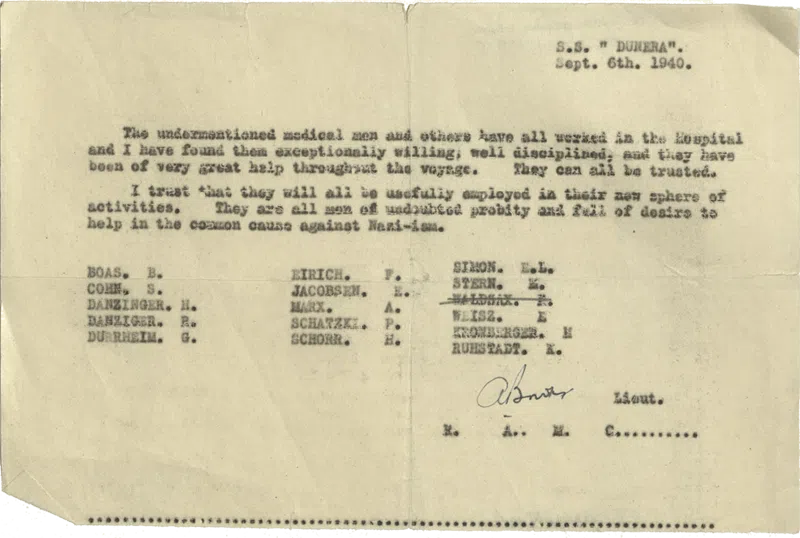
In this letter, military doctor Lieutenant A. Brooks confirmed the valuable assistance he received from internees – doctors and other helpers – in the ship’s hospital during the Dunera’s voyage. It contains a list of 15 names of his helpers. The article about Lieutenant Brooks was supplemented with detailed notes on this. The letter was found in documents from the estate of Dunera boy Friedrich Eirich, which are kept in the German Exile Archive 1933-1945 at the German National Library, Frankfurt am Main.
Book announcement: Dunera Boy and art historian Ernst Kitzinger
Seumas Spark, Andrew McNamara, and Kate Garrett commemorate Ernst Kitzinger, the Dunera Boy, in a new book. The art historian, born on December 27, 1912, in Munich and deceased on January 22, 2003, in Poughkeepsie (USA), worked in exile from 1935 for the Medieval Department of the British Museum.
Seumas Spark, Kate Garrett, Andrew McNamara, „Voices of the Dunera. Ernst Kitzinger, Exile and Essays on Internment“. 130 pages. Publisher: Berghahn New York Oxford. ISBN 978-1-83695-443-9 (eBook eISBN 978-1-83695-444-6), to be published in April 2026. The price is listed as US$120.00 or £92.00.

After deportation and internment, he went to the USA, where he served for many years as director of the Center for Byzantine Studies and researched Christian art from the 3rd to the 12th century. “Kitzinger never sought the limelight; he was too shy, too hurt, and above all too discreet for that. His authority did not come from his positions, but from his research and his friendly modesty,” according to an obituary by the Bavarian Academy of Sciences. The Federal Republic of Germany honored him in 1982 by admitting him to the Order Pour le Mérite.
Spark, McNamara and Garrett about Kitzinger:
Kitzinger rallied his fellow internees to communicate their peculiar circumstances. In powerful and often deeply moving prose and poetry, they mused on their lot and the misfortunes of refugees. Never before published, their words remain strikingly relevant today.
