
By early 1942, the economic situation in Australia had become precarious: 100,000 men had been drafted into the military, leaving a shortage of workers in the economy. The labor shortages, particularly in the transportatioffruitn and construction sectors, had to be addressed. The Australian government was forced to begin employing non-naturalized immigrants and “enemy aliens” as well. The internees of the Dunera and Queen Mary were promised Australian citizenship if they made themselves useful in furthering the war effort. Certainly, military service was linked to the expectation of escaping isolation in the internment camps at Tatura. However, neither the internees nor the migrants were permitted to serve in the armed forces. The 8th Australian Employment Company was a very special work unit.
Peter Dehn, June 2026
“… every human being in this country …“
In 1938, Australia’s representative Thomas Walter White had distinguished himself at the Evian Conference regarding the treatment of Jewish refugees with the following statement: “Since we have no real racial problem, we are not willing to import one.” In light of the new situation, the stance was no longer “Our population is 99.1% of British nationality[1] Zitat aus einer Wahlkampfrede von Joseph Lyons am 28. September 1937. and we wish to keep it so.”
In 1945, the communist politician Richard Dixon[2] Richard Dixon, “Immigration and the ‘White Australia Policy’,” Sydney, 1945. Accessed May 12, 2026. described the “White Australia Policy[3] The “Immigration Restriction Act” was one of the first laws passed by the new Parliament in 1901 and was not repealed until 1975. See, among others, National Archives of Australia, National Museum of Australia. Wikipedia on the “White Australia Policy.” Accessed March 15, 2026.,” introduced in Australia in 1901, as a different version of Hitler’s racial theory, directed in Australia against Indians, Chinese, and Indonesians, who were Australia’s allies during World War II. In mid-1940, Churchill targeted refugees who had fled Nazi persecution—and were thus natural allies of the Allies in the fight against Hitler—for mass internment and deportation.
War-related compromises regarding the “White Australia Policy”

The bombing of Darwin on February 19, 1942. Source: Wikipedia (public domain).
The Japanese attacks on Pearl Harbor[4] Japan entered the war with the attack on Pearl Harbor on December 7, 1941, accessed on August 25, 2025. in December 1941 and Darwin[5] Wikipedia on the air raids on Australia, accessed on 25 August 2025. on February 19, 1942, triggered a mass mobilization[6] Bartrop, Paul „‘Enemy Aliens‘ and the Formation auf Australia’s 8th Employment Company“. In „Manpower and the Armies of the British Empire in the Two World Wars“, 2021, ISBN 9781501755866, Seite 134ff. of 100,000 soldiers in Australia. As a result, the Australian government was forced to set aside the xenophobia and racism associated with the “White Australia Policy” in order to replace the resulting labor shortage. The change in government to the Labor Party may also have contributed to this policy shift. Prime Minister John Curtin[7] Quoted from June Factor, *Soldiers and Aliens*, Melbourne 2022, ISBN 9780522878585, p. 34. (Labor Party) outlined the new strategy in February 1942:
“That means clearly and specifically that every human being in this country is now, whether he or she likes it, at the service of the Government to work in the defense of Australia …”
“Every human being in this country ” — that included the mobilization of “non-British subjects.” Tens of thousands of men of military age, internees and migrants alike, regardless of their origin, religion, or race, were now deemed fit enough to contribute to the defense of the country. As long as they didn’t get their hands on weapons.
15,000 men in labour companies
The Australian Army established 39 labor units. Eleven companies[8] See “Works / Labour / Employment Company/ies,” Virtual War Memorial Australia. Accessed May 12, 2026. were staffed entirely or partially by “aliens”—internees or Australians with roots in enemy nations. These companies of foreigners were organized by language group and operated in designated states. Initially, they were designated as “Works Companies” or “Labor Companies” and reached a combined strength of up to 15,000 men[9] une Factor, “Forgotten Soldiers: Aliens in the Australian Army’s Employment Companies During World War II,” p. 1, online. Accessed May 15, 2026..
The 2nd and 3rd Companies were stationed in New South Wales. German refugees also served in the 3rd Company.
The 4th, 6th, and 8th Companies, staffed by German-speaking personnel, worked in Victoria.
The Chinese 7th Company was established in Fremantle (Western Australia) and later transferred to Queensland.
The 10th Company in South Australia was not officially an “Alien” unit, but had a “significant foreign element.”
The 11th Company was attached to the 12th after a short time.
The 12th Company, also with German-speaking personnel, was transferred from Western Australia to the Northern Territories.
The 23rd Company included “Koepangoese”—migrants from the then-Dutch colony of West Timor (now part of Indonesia).
The 36th Company comprised Indonesians, who were often referred to in Australia as “Javanese” after the largest ethnic group there.
Under the auspices of the Allied Works Council[10] Wikipedia on the AWC. Accessed on May 15, 2026. (AWC), primarily Italian internees were enlisted in the Civil Alien Corps (CAC) beginning in 1943. By the time it was disbanded in May 1945, 1,671 of the 15,601 officially registered “aliens” had worked in road construction and forestry in Western Australia[11] Civilian Alien Corps records held in Perth; NAA Fact Sheet No. 182. Accessed on May 13, 2026.. The AWC also oversaw the Civil Constructional Corps[12] Wikipedia on the Civil Construction Corps. Accessed on April 20, 2026. (CCC), whose 53,500 volunteered or conscripted Australians built airfields, anti-aircraft gun emplacements, barracks, and other military facilities throughout Australia.
Major Layton comes out on top
The number of deported refugees in internment camps had by then fallen significantly: By early 1942, some 1,300 men[13] Memorandum to the Australian Cabinet dated February 23, 1944, cited in Bartrop and Eisen, *The Dunera Affair*, Melbourne 1990, ISBN 1 86337 025-0, p. 127. from the Dunera had been brought to Great Britain to serve in unarmed engineering units or perform other tasks vital to the war effort. Some traveled on to third countries such as the United States and Palestine. Major Julian Layton, who was tasked with winding down the camps in Australia, had advocated for this upon his arrival in March 1941.
By then, it was clear that the internments would end. Hundreds of remaining internees were deployed in January 1942 as fruit pickers[14] Quoted from Bartrop, “Enemy Aliens,” op. cit., p. 139. on farms in the region around Tatura and neighboring Shepparton. “There was no barbed wire, no guards, no officers or soldiers, nothing but kindness, and we felt as if we were their guests … To make a long story short: We were happy.“
Around the same time, Layton persuaded the Australian government to accept internees into the Australian Army. “Ultimately after many exhausting interviews and negotiations this was agreed to“, Layton recalled[15] Interview with J. Layton, recorded at the Imperial War Museum, London. Quoted from Bartrop/Eisen, op. cit., p. 124., adding: Australia could not really reject this proposal; it was well known that many “aliens”—and not just Germans—served in the British Auxiliary Military Pioneer Corps (A.M.P.C.). Some later volunteered for the fighting force and were accepted. The “No. 10 (Inter-Allied) Commando” consisted entirely of “enemy aliens”; in its No. 3 Troop (“X Commando”), more than 80 German speakers served, including nine former Dunera Boys.
The Allure of Citizenship
“Everyone came forward; even those over 60 were officially instructed to state their age as no more than about 40,” recalled Franz Lebrecht, an internee at the Queen Mary. “However, very few of them signed up out of enthusiasm; they mainly signed up because they saw it as a chance to get out,” he continued[16] Lebrecht, Franz, „Bericht über Erlebnisse während der Zeit des Dritten Reiches, - u.a. aus 4 Konzentrationslagern“ from April 10, 1960, Wiener Library, London, p. 26..
The announcement that their service would be rewarded with Australian citizenship or a permanent residence permit was very welcome news to the internees. A briefing for a speech by the Australian Minister of Defense[17] Cf. Minute of the General-Adjudant to Australian Parliarment from 29.3.1946. NAA_ItemNumber4938132, page 28, point d. provided context for this in 1946:
“Owing to transport difficulties it was not possible to return to the UK, the refugee aliens held in Australia and they were permitted to volunteer for service in the AMF[18] Wikipedia on the Australian Military Forces (AMF), accessed on March 30, 2026. Accessed on April 15, 2026.. Those who were medically fit for service were enlisted and posted to 8 Employment Coy. Enemy aliens who could not be classified as refugees were not permitted to enlist.”
Many of the internees deported to Australia by the British would have liked to have fought alongside the Allies with a weapon at their side. “I myself, having already volunteered for the front lines during my internment along with about three other men, said with bitter irony: ‘We are defending the 70th defense line[19] Lebrecht loc.cit., page 27.’.”
Heinz Werner Margulies [20] Heinz Werner Margulies (Margate); memoir *The Bear to the Southern Cross*, Chapter 14, quoted from "Dunera News" No. 97, June 2016, page 22.put it even more bluntly in retrospect:
“Although they had allowed me to enlist in the Australian Army, they wouldn’t permit me to join a fighting unit, for my own good they said. I had wanted to go up north to Papua New Guinea, but they believed hat as a German, I might find I was not completely trusted by my unit, which would affect the cohesiveness of the unit, and possibly my safety too. If something happened to me, no one would know whether it was by a bullet from the enemy or one from my own unit!”
“A new life of own choosing begins”
After Major Layton[21] “Julian Layton, Stockbroker and Soldier” in K. Inglis, B. Gammage, S. Spark, J. Winter, C. Bunyan, *Dunera Lives – Profiles*, Melbourne 2020, ISBN 9781925835659, p. 41. had secured the admission of former internees into the Australian Army, he arranged for about 400 internees to be transported from the Tatura camp to Melbourne to enlist as volunteers. On April 7, 1940, he went there himself. “ The men looked somewhat bewildered,” he wrote. However, they were well aware that they were near the gates of freedom.
Dunera Boy Klaus Wilczynski[22] Klaus Wilczynski, *Das Gefangenenschiff*, Berlin 2001, ISBN 5-89793-044-7, p. 293. recalls:
“My life as an internee began on a fenced-in sports field far away; it ends once and for all, irrevocably, on a racetrack, and a new life of my own choosing begins.”

Harry Jay may have photographed this scene in 1945. Source: Friedländer Collection.
Over time, more than 500 internees[23] Research by dunera.de in the personnel and military files of the internees at the National Archives of Australia and the “Nominal Rolls” of the Australian government’s Department of Veterans’ Affairs (DVA). See memorandum to the Australian Cabinet dated February 23, 1944, in Bartrop/Eisen, op. cit., p. 127. The document mentions 549 enlistments and 474 ongoing internments. Retrieved on May 20, 2026. of the Dunera and the Queen Mary responded to the call for voluntary service in the Australian Army. Among the survivors of the Arandora Star, 22 German speakers and one Italian had volunteered. In addition, there were 49 Germans and Austrians and six Italians from the Queen Mary group. Beyond that, only a few other refugees were permanently accepted; one known example is Ernst Friedlich.
For the families deported from Singapore, volunteering for military service had another tangible benefit: their wives and children were “released on parole” shortly after their husbands began their service. This official notation, however, conveys official mistrust and can even be found in the records of infants and schoolchildren. Most families settled in Melbourne to be close to their spouses.
Of the eight men in the “Shanghai 12,” five had also volunteered. They had never been interned and were drafted into the 4th, 6th, or 12th Employment Companies.
The 8th Australian Employment Company
The former internees were grouped into a unit established specifically for them. Its history began as the “8th Labour Company[24] War diary of the 8th Australian Employment Company, 1/2.” on April 7, 1942, with 453 soldiers. The composition of the unit reflects the difficulty of uniting such a diverse group into a cohesive whole. Historian June Factor describes the unique aspects[25] June Factor, *Soldiers and Aliens*, op. cit., blurb. that was reflected in many labor companies—most strongly in the 8AEC:
„Scholars and peasents, musicians and factory wirkers, communists and royalists, Jews and Catholics, animists and atheistsw, they all layboured under standard strict Army regulations, living in tens and huts, loading and unloading trains, working the wharves, cutting timber, and transporting goods.“

“Work and work” – the coat of arms was designed by Pte. Emil Wittenberg. Courtesy of Martin F. Burman.
Initial tasks
On the first day, their commander, Captain Edward Renata Muhunga Broughton, had granted all the soldiers a day off—a brief respite. For they were immediately put to work on general tasks around the camp. “ Outside working parties were supplied 2 days after formation of 8th Labour Coy, when 3 NCOs and 124 O/Rs[26] War diary, loc.cit., 1/2. were engaged in diggiging slit trenches, loading dry Hessian and general stores.”
An unnamed soldier reports: “We are digging trenches. We are only working 30 minutes in an hour and during those 30 minutes we take it very easy,” he wrote to “Boomerang[27] “Boomerang” No. 31, May 1942; camp newspaper at Tatura Camp 2. Quoted in Bartrop/Eisen, op. cit., p. 364.”, the magazine of his former internment camp.
By April 13, more than 250 men were already working outside the camp[28] War diary, loc. cit. 1/2.. “On various occasions all night working parties were supplied for the purpose of unloading ships at the Victoria Docks. ” The Port of Melbourne became one of the regular locations.
Lieutenants and non-commissioned officers
Captain Broughton initially had four lieutenants under his command. All had already served in World War I, and some had fought in France, among other places. At the outset, the unit included three Australian sergeants; within a short time, nine additional NCOs (non-commissioned officers) were assigned to it. They, too, were remobilized veterans of World War I and were therefore over 40 years old. Looking back, Broughton was harsh in his judgment[29] Quoted from “Dunera Lives – Profiles,” op. cit., p. 10. of them: “Half of them could not have lifted a paper-back and the other half would have dropped it. … But they could all give orders which no-one obeyed anyway.”
There was a need to fill a large number of vacant positions and to adhere to staffing ratios. But Broughton also integrated “aliens” into the unit’s structure from the very beginning for psychological reasons. As early as May 11, 1942, Paul Allert, Bruno Friedländer, Bruno Kluger, and Alfred Lewinsky were the first former internees to be promoted to Lance Corporals[30] War diary, 1/17, 1/75, 3/46.. By the end of August, more than 20 “aliens” were serving, and by the end of the year, at least 39 Australian and “alien” non-commissioned officers were on duty.
The final name
On June 17, 1942, the company’s base was moved from Royal Park in the suburb of Caulfield to Camp Pell in Parkville, closer to Melbourne’s city center and harbor. On October 8, 1942, the unit received its final designation: 8th Australian Employment Company[31] War diary, 2/105.. On December 26, 1942, the 8AEC consisted of six officers and 531 men. By the end of the year, at least 39 Australian and “alien” non-commissioned officers were on duty.

View of part of Camp Pell. Argus Newspaper Collection, State Library of Victoria.
A very special unit
Captain Broughton found himself in charge of a very special unit, but the half-Maori veteran of the Battle of Gallipoli managed to earn the respect, admiration, and gratitude of “his” men.
Jewish majority
An important aspect was Broughton’s respect for the Jewish majority under his command. He educated himself on the fundamentals and customs of Judaism. He allowed religious soldiers to attend services, provided that the unit’s duties were not hindered. Christian soldiers[32] War diary, 2/134. had the same rights. On May 21, 1942, for example, the Company Routine Order announced Jewish services at the Toorak Synagogue. He provided Jewish soldiers who had no contact with Australian families with a pound of matzo[33] War diary, 5/33. for the Seder. On May 23, 1940, among other dates, the daily order provided information about services of four Christian denominations. Broughton took great care to ensure that soldiers did not benefit from freedoms[34] War diary, 1/28, 1/30. granted to members of both religions.
On the side, “Tip” Broughton—also known as “Skipper” in the lingo—learned German. Occasionally, he even gave speeches in German, with a non-commissioned officer helping him out by whispering corrections[35] From “Dunera Lives – Profiles,” op. cit., p. 13..
Another distinctive feature of the 8AEC was the wide range of professional skills among its members—particularly in intellectual fields, but also in the trades. The age range of the soldiers was equally broad, spanning from 18 to nearly 60 years old.

The 1943 Christmas menu (left) and the 1944 Passover menu, both for the Tocumwal detachment. Courtesy of the Jewish Museum of Australia, collection numbers 3646 and 4148.
Everyday Life in the Military
Captain Broughton always prefaced his daily orders with the daily schedule[36] War Diary, 2/49. The information provided here is illustrative and has been revised several times. at Camp Pell:
| Reveille | 0530 hrs | Evening meal | 1730 hrs | |
| Breakfast | 0630 hrs | First post | 2130 hrs | |
| Sick parade | 0730 hrs | Last post | 2200 hrs | |
| Midday meal | 1200 hrs | Lights off | 2215 hrs |
Guard duty had to be covered every day. Initially, a lieutenant and two Australian non-commissioned officers were assigned to this task. As early as April 10, Broughton promoted 10 soldiers to corporal. The names of those promoted were announced in the daily orders, which, however, were not issued until July 14, 1942. Starting in October 1942, this task was occasionally entrusted to two “foreign” NCOs without Australian “supervision.” During the later field detachment in Albury, a “foreign” NCO led the guard duty with six Ptes.
Dress code and …
It is well known that an army places great importance on its dress code. More than a few soldiers have been punished by the “Skipper” after being caught by military police in town wearing their uniforms improperly. On several occasions, Broughton gave clear instructions regarding the dress code[37] War diary, 2/22. — including the correct way to wear the “slouch hat,” the legendary headgear of the Australian and New Zealand armies.
“Members of this Coy are once again warned against the preactice of parading in the streets with their jackets unbuttoned an their hats incorrectly ceased. If this practice vontinues, it will a reflection on the whole of the 8th Labour Coy, apart from the disciplinary action that will be taken.”

The badge needs to be attached to the slouch hat—but how? Source: Friedländer Collection.
… supple leather
To outsiders, the official instructions from the High Command on breaking in boots[38] Order from Vic L of C, R/O 122/42, in the War diary, 1/60. — which Broughton passed on — seem amusing.
“After careful fitting, the man should stand in about three inches of water for about 20 minutes, or until the leather becomes thoroughly wet and pliable and in a condition to stretch easily …”
Leisure activities
After years behind bars, being stationed in the big city of Melbourne was a breath of fresh air for all the soldiers. “Military life is no picnic, but I can think of worse conditions,” historian Paul R. Bartrop[39] Bartrop, *Enemy Aliens*, op. cit., p. 142. quotes a soldier.

The department store chain Myer operated the “Dug-Out” club for soldiers in downtown Melbourne, which Charles William Bush painted in March 1943: Source: Australian War Memorial No. ART23689 (public domain).
Many reported with enthusiasm that they could once again attend concerts and watch movies. They visited bars, met women, and gathered at the military club “Dug-Out[40] The “Dug-Out” was a club for Allied military personnel in downtown Melbourne.” or other venues to dance.
The Army organized lectures, concerts, and movie nights; occasionally, the Army’s “mobile entertainment” groups performed at Camp Pell. On December 13, 1942, the 8AEC was invited to a singing evening featuring the tenor and fellow internees and soldiers Erich (Eric) Liffmann[41] War Diary, 3/64. Tenor Erich Liffmann served as a private in the 8th Employment Company from August 8, 1942, to February 7, 1946; Captain Broughton gave him the opportunity to perform outside the military as well..
In October 1942, the “Skipper” strongly recommended that off-duty soldiers attend an illustrated talk by the Education Department on the topic “The Red Army and the Russian People[42] War diary, 2/111, 2/112, 2/114..” “The commander wishes as many men from this unit as possible to attend this event, which is of great relevance to everyone.” The following day, Broughton announced that all leave passes had been collected; “the entire company” had to assemble at 7:15 p.m. and march to the mess hall to attend this talk. Broughton established himself as a speaker with a series of talks on New Zealand[43] War diary 4/68..
One year after its founding[44] War diary, 5/48., seven officers and 511 enlisted men served in the 8th Employment Company.
Employment, entertainment or enjoyment?

The weekly newspaper “Radio News” praised Erich Liffmann for a radio concert in May 1942. Source: Wikipedia.
The high intellectual potential of many foreign companies made it possible for them to pursue their own artistic activities. In the 8th Australian Employment Company, this was particularly pronounced—a continuation of the activities that had taken place during their internment. Captain Broughton allowed many of his young soldiers to pursue distance learning and excused them from duty for required classes and exams. On many occasions, the numerous musicians and artists among the soldiers presented concerts and theater evenings to the residents of their duty stations. At times, they joked self-deprecatingly that they were serving in the “8th Entertainment Company.”
An outstanding example of Broughton’s support was the tenor Erich Liffmann[45] “Radio Times,” Melbourne, May 17–23, 1942, cited in Wikipedia about Liffmann, accessed April 20, 2026.. He was able to sing on the radio in May 1942; “a sensation from the very first note,” wrote one newspaper, explicitly noting that he was a soldier in the “8th Labor Battalion.” In addition to his duties in the army, Liffmann was able to establish himself for a postwar career in Melbourne’s music scene. The euphoric reviews made it easier for Broughton to approve special leave for events. “His performance activities assisted in raising thousands of pounds for the war effort and associated charities.”
All the soldiers showed solidarity and were generous with their donations[46] War diary, 7/71, 7/105, 8/50, 8/38.. The C.O. expressed his gratitude for the participation in a war bond drive, the proceeds of which had risen from 1,000 to 1,120 pounds. Broughton quoted a letter of thanks “for the wonderful show” with which the unit in Tocumwal had supported the war bond drive. The Tocumwal unit raised 45 pounds for an injured railway worker, a union publication reported gratefully. In February 1944, 72 men from the Camp Pell detachment assisted in fighting bushfires in Yallourn and repaired tracks used by coal dredges, among other tasks.
On March 12, 1943, the C.O. thanked “… the Orchestra of the 8 Aust Employment Coy who rendered such an excellent programme at the opening on Tuesday evening of the CWO hut.” Noteworthy: Jewish musicians performed at the opening of a band hall for the Catholic Welfare Organization[47] War diary, 5/16. See also “St. Anne’s Park Orchards – The Church that Travelled.” Accessed May 20, 2026. (CWO) at Camp Pell.
Snow White at the loading dock
The most significant event in the unit’s cultural life was the performance of “Sgt. Snow White”. Sergeant Kurt “Doc” Sternberg had developed the satirical anti-fascist musical revue using material from performances in Hay and Tatura, along with new material. Soldiers wrote songs and crafted the sets and costumes. Naturally, soldiers took the stage; Liffmann played the lead role of Prince Charming. To mark the first anniversary of the 8AEC, the play premiered on April 17, 1943, at the Union Theatre in Melbourne, with additional performances to follow. It was celebrated in the Melbourne press as a groundbreaking theatrical concept, and repeat performances ensued.
The satire touches on exile, internment, and military service. For example, the dialogue mentions the “8th Enjoyment Company[48] Dr Albrecht Dümling, "The Vanished Musicians", Oxford 2016, ISBN 9783034319515, p. 298.,” which is, of course, immediately corrected. The “Skipper” had helped with the preparations and execution and didn’t shy away from making a small cameo appearance[49] Inglis, Spark et al. „Dunera Lives. Profiles“, Melbourne 2020, page 13..

In June 1943, “Pix Magazine” published an extensive photo feature on “Sgt. Snow White.” The photos were taken by Dunera Boy Harry Jay, who later made a name for himself as a theater photographer in Melbourne. Source: Trove Archive, Australia.
Sergeant Sigurd Lohde had performed the song “Sounds of Europe” on stage. The war diary notes on August 12, 1943[50] War diary, 6/79.: “Sgt. Baer and Pte Hochberger win 1st Prize in the A.B.C. Competition for Music and Verse.” Music historian Albrecht Dümling adds: “They [the jury] were surprised to learn that ‘Sounds of Europe’ was the work not of Australian soldiers, but of two aliens. The ABC broadcast the song nationwide, but decided not to publish it[51] Dümling op. cit., page 306..”
From August 27 to September 10, 1943, Captain Broughton was hospitalized. He received many telegraphic get-well messages from “his” men. He was replaced by Captain Walker[52] War diary, 4/82., C.O. of the 4th AEC in Albury.
Albury and Tocumwal
On September 5, 1942, a detachment of the 8AEC was first sent to Albury: Lieutenant Latter and 116 men were attached to the 4th Labour Company there until December 10. Another 16 men under Lieutenant Hockenhull left Melbourne on September 16, 1942, to report to the 6th Labour Company in Tocumwal[53] War diary, 2/66f. (New South Wales).
Break-of-gauge
The train stations in both towns, along with the Port of Melbourne, became the 8th Employment Company’s most important operational bases. The small town of Albury on the southern border of New South Wales was logistically important because it was where incompatible railway systems converged. Trains from Sydney (New South Wales) ran on “European” tracks with a gauge of 1,435 millimeters. To the south, toward Melbourne (Victoria), “broad-gauge” tracks (1,600 mm gauge) were used. As a result, military and civilian goods had to be transferred at state borders.
Albury Station
Between 1938 and 1941, freight traffic in Albury had already risen from 25,000 to 123,000 tons. Due to its strategic importance, the armed forces had “effectively requisitioned the station for the duration of World War II.” Rotating groups from the 8AEC were tasked with the loading operations. To allow two trains to stand in line at Albury and be loaded and unloaded, the platform in Albury[54] Wikipedia on Albury Station. Accessed on July 20, 2025. was extended by 66 meters to a length of 455 meters – the longest platform in Australia. In Woodonga, the next station and the first in the state of Victoria, livestock was transferred.
In Albury, the unit was housed in tents at the Albury East Racecourse. There were no horse races during the war; the racetracks, with their large open spaces, were therefore used by the military to set up large numbers of tents.

Albury Station 2023: There is no trace left of its former importance. Photo: Dehn.
„Not a home away from hom“
„In the winter of ’43 our tents were pitched on the once grassy expanse of Albury Showgrounds. The site was not a home away from home,“ Bern Brent[55] Bern Brent "The Long and the Short and the Tall"; in Dunera News No. 36, pages 11f. (Gerd Bernstein) revalled. „The nights were cold and wet and the ground muddy. The only semi-permanent structure served as a mess during the day and as a recreation hut in the evening. Every night it filled with a raucos collection of off-duty-men, mostly from another Employment Company. Cigarette smoke wafted from the ceiling as they played poker, pontoon, crown-and-anchor, and Rickety Kate.“
Leisure activities were, of course, few and far between in the small town of Albury[56] Wikipedia on Albury. Accessed on July 20, 2025., which had a population of barely 14,000 during the war. Bern Brent: „For everyone with an evening’s leave pass there was little to do in town. There were the pictures, there was the Terminus Hotel, and there was the only open at night, the hamburger shop in Dean Street. It was a case of early-to-bed and early-to-rise fore most of us.“
Tocumwal Station
A similar border situation existed in Tocumwal[57] Wikipedia on Tocumwal, Tocumwal Station, and the Tocumwal houses. Accessed on July 20, 2025., about 150 kilometers west of Albury. As in Albury, the Murray River forms the border there. In this small town, which belongs to New South Wales, military service was just as difficult and recreational opportunities were by no means better, even though a military airfield operated there from 1942 to 1944. After the war, 200 houses built for the military and their families were dismantled and reassembled in Canberra to house workers for the new capital. For an extended period, several hundred men were stationed in Albury and Tocumwal, and Captain Broughton was compelled to relocate his headquarters to Tocumwal.
Tocumwal has fewer than 3,000 residents today; passenger trains no longer stop there.

A freight train at the Tocumwal station. The historic building houses a railroad museum. Photo: Dehn.
A tragic swimming accident
On December 30, 1943, a tragic accident occurred: In Tocumwal, soldiers Ulrich Laufer (20) and Max Schwarz (26) of the 8th Employment Company drowned in the Murray River while swimming on a hot summer evening. Captain Broughton and several soldiers were only able to recover the body of Max Schwarz. The Dunera Boy and army comrade Walter Pollak, who like Max Schwarz was from Vienna, recalled a later conversation[58] Walter Pollak „Captain E.R.M. Broughton“ in Dunera News no. 24 (June 1992), page 7, retrieved on 16.11.2024. with the C.O. about the two comrades:
“This accident affected me more than I can tell you. Two young men who went through the trauma of beeing torn from their families as youngsters, shipped off to a strange country, interned for 2 1/2 years and finally, before getting to know the beauty of life, ended up as 2 bloated corpses on the river banks.”
Turnover
The war diary provides insight into personnel turnover in the 8th Employment Company. Only a few men were transferred — and not to combat units. As early as May 6 and 7, 1942, three discharges[59] War diary, 1/3. were recorded without names or reasons.
Transfers
In response to a call in November 1943 for Italian interpreters[60] War diary, 7/77. in prisoner-of-war camps, about ten “aliens” from the 8AEC volunteered. They were transferred to the 23rd Garrison Battalion in Murchison (near Tatura).
Doc Sternberg, a film producer in civilian life, was transferred to NEFIS[61] Wikipedia on NEFIS. Accessed on May 8, 2026. in February 1944. This was a unit of the Dutch intelligence service stationed in Melbourne, where he was able to apply his skills to the production of propaganda films[62] Kurt Sternberg's military file, NAA..
Fourteen Germans and Austrians from Employment Companies, including eight soldiers from the 8AEC, had volunteered to participate in the Army’s malaria experiments. A first group was transferred to Cairns on December 8, 1944, “as Malaria Volunteers[63] War diary, 9/138..” The volunteers saw their risky participation as the opportunity to make a greater impact in the fight against the Axis powers than they could as labor soldiers.

Laborers: Alfred Broch, Walter Hofstaedter (one of the youngest internees), Heinz Altschul, Viktor Gussmann, Gerhard Sonnewald (from left). Source: Donated by Jimmy King to the Jewish Museum of Australia, Melbourne (No. 4436).
However, requests for transfer to the front lines were regularly denied. The war diary contains, among other things, two lists[64] War diary, 4/18, 4/32. from January 1943 listing the names od seven and five men, respectively, whose requests were denied.
Discharges into civilian life
“Medically unfit” were the most common cause of discharges during the unit’s first two years.
Even in the early days of the Employment Company, there were numerous requests to switch to civilian occupations. The headquarters[65] War diary, 1/13, 1/14. responsible for internees and prisoners of war explicitly stated as much as early as May 1942:

“… that only after exhaustive inquieries by the High Command will perssion to transfer from this unit be given. As a matter of routine applications for transfers will not be entertained. The only alternative to the Labour Unit is re-internment.”
This “must on no account be misconstrued as a threat,” Broughton reassured the agitated crowd the next day; requests for discharge to civilian employment could be submitted to the company office.
There were, however, exceptions: For example, Lance Corporal Leon Gottlieb was discharged in November 1944 to support Australia’s war effort as an engineer in the “Armored Fighting Vehicles” sector.
On June 1, 1943, the rejection of another application for discharge to civilian employment was reported. On the other hand, on June 4, two men were discharged to “national industry.” On November 30, 1943, it was noted: “Pte Ansbacher[66] War diary, 6/7, 6/10, 7/66. marches out for release to become Minister of the Jewish Community at Hobart / Tas.”
Large-scale demobilizations did not begin until 1944.
Discipline, Punishments, Court-Martial
Many of the “alien” conscripts were fundamentally critical of—or even opposed to—military customs, and not just once they arrived in Australia. Blind obedience was often rejected. During his military career, Captain Broughton had certainly never encountered a unit where, “when he gave an order, the reply inevitably came back, ‚Why?[67] Bartrop, “Enemy Aliens,” op. cit., p. 140.‘” noted Australian historian Paul R. Bartrop.
As a result, many punishments were handed down for insubordination, unauthorized absence, or rude remarks to superiors. It seems, however, that Captain Broughton, whenever possible, settled for minor punishments. He often responded to complaints by suspending leave for a few days up to two weeks or by imposing small fines, which were announced in the company routine orders.
When it came to disciplinary matters, two men stood out for receiving particularly frequent punishments. Broughton sentenced a German man to imprisonment on multiple occasions[68] War diary, 7/61., including a 28-day sentence in November 1943. A court-martial[69] War diary, 5/22, 7/77. even sentenced an Italian man to two months’ imprisonment for “illegal possessions.” The Italian was already no stranger to military prison; because he had threatened two German NCOs with murder when they admonished him to behave while he was on the back of a moving truck, he spent 14 days behind bars.
Broughton’s successor, Major Lotherington, took a much harsher approach whenever he found a reason to do so. In 1944 and 1945, he occasionally published lists of “punishments.” In some cases, multiple penalties were imposed. By the end of 1944, it almost seemed as though one man was being punished every day (primarily for unauthorized absence) with suspension of leave, fines, or pay cuts. This reached a peak when 16 punishments[70] War diary, 9/48, 9/180, 9/216. were announced each on August 25, 1944, January 25, 1945, and February 14, 1945.
Another case documents how Lotherington sought to enforce blind obedience. On May 10, 1945 (two days after the Nazi Wehrmacht’s surrender), the 23-year-old soldier M. J. Levin was sentenced by a court-martial to 28 days’ imprisonment and a fine of five pounds. He had complained in writing to the C.O. about a lieutenant[71] Military file M.J. Levin, NAA_ItemNumber7598097.: “In this unit I am beeing treated like a school boy, herded about the parade ground by a professional officer whose only ambition in life seems to be bigger and better wars.”
Later, under the command of Major Sugden, punishments were handed down on a fairly regular basis. The exception was the punishment of 20 men[72] War diary, 10/143. for unauthorized absence on August 8, 1945.
Captain Broughton – a father figure
His soldiers spoke of their first C.O., Captain “Tip” Broughton, with great fondness. Some met with him long after the war, and he was occasionally asked to serve as a best man. Much later, it was the Dunera Boys who ensured that he received a honoring headstone.
“Broughton became a father figure[73] Myffanwy Bryant, “A Most Unexpected Friend,” Australian National Maritime Museum blog, March 4, 2016. Accessed March 19, 2026. to many of the younger men. His guidance and encouragement went a long way to install hope to those who had lost everything and a tentative faith that they may have a future in Australia.”
On May 15, 1944, Captain Broughton’s transfer from Tocumwal to Broadmeadows was reported, where he was demobilized. Major Lotherington[74] War diary, 8/112. took command of the 8AEC. As far as is known, his subordinates left no recollections of him or his successors.

Soldiers from the 8th Employment Company form a guard of honor for their “Skipper” in 1943. Gift from Heinz Lippmann to the Australian National Maritime Museum, Sydney, No. ANMS022-006.
The End of the 8AEC
The unit’s strength continued to decline: On December 31, 1944, the 8th Employment Company consisted of 8 officers and 442 enlisted men. A year earlier[75] War diary, 7/46, 9/142., there had been 7 officers and 511 other ranks. While the 8AEC’s enlisted ranks were further reduced over the course of 1945, the number of officers increased dramatically. As of August 4, 1945, C.O. Major Sugden commanded one captain and eleven lieutenants, but only 402 men[76] War diary, 10/171 ff., 10/183..
On October 20, 1945, Captain Boileau joined the 8AEC, initially as “2 i/c” – deputy to the C.O. He took command of the 8AEC on November 17, 1945. However, he was not designated as C.O., but rather as “Administering Command[77] War diary, 10/267.,” i.e., administrative head. This gives the impression that his task was the disbandment of the 8th Employment Company. At the turn of the year 1945/46, he commanded seven officers and only 316 soldiers and NCOs. On January 13, 1946, the headquarters of the 8AEC was relocated from Albury back to Camp Pell (Melbourne). On January 28, 1946, the unit still consisted of 7 officers and 248 enlisted men[78] War diary, 10/282, 10/309..
The entries in this war diary end on January 31, 1946. That cannot have been the end of the 8th Employment Company. Between February and September 1946, more than 50 of the approximately 125 “alien” NCOs were discharged. Three non-commissioned officers were demobilized in the fourth quarter of 1946, and one as late as January 6, 1947. The records of these men list the 8th Employment Company[79] Research by dunera.de based on military personnel files in the NAA. This does not include men from the 8AEC whose service ended after they were transferred to other units. as their last unit.
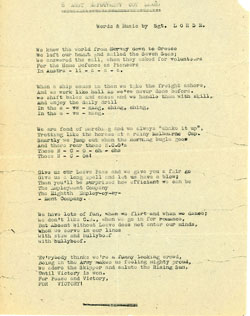
Sgt. Sigurd Lohde wrote the lyrics and music for “8 Aust Employment Coy March.” Courtesy of the Jewish Museum of Australia, accession no. 4466.
“A symbol of tolerance and decency”
From April 1942 until the end of 1946, the 8th Employment Company had earned the respect of those with whom it worked. The Head of the Melbourne Docks[80] „Edward Broughton. Soldier and Bookmaker“ in K. Inglis, et al „Dunera Lives – Profiles“ aao., p. 10. was one of the first to express his high regard for the men assigned to him:
“8 Labour Coy (Internee Alien) in a large measure is composed of men quite unused to heavy manual labour. Craftsmen and professional men are in large proportion. Many are unfitted by age and condition for manual work… They have, however, throughout the three months… under Docks control, given willing and obedient service, superior to that given by any Australian unit… The sickness rate is higher than usual, attributable to the men being unaccustomed to open-air life and manual labour. They eagerly offer for technical work of any sort … they make up in diligence and pleasant obedience for their lack of physical strength… “
In April 1943—the Eighth had been active for a year—the Army magazine “Salt” summarized its impression of the “aliens”[81] “Salt,” op. cit., pp. 36–39, quoted from Bartrop/Eisen, op. cit., pp. 365 ff.:
“There is no grim glory about it, but it is hard, back-breaking, monotonous – loading and unloading on docks, at depots and dumps. (…) To these men their Australian uniform is a symbol of tolerance, decency. Australian and Australians have received their flagging faith in mankind. We can be proud of them.”
In late November 1943, by contrast, the top brass of the Australian Army Command[82] Circular from the Quartermaster General dated November 29, 1943, in War diary, op. cit., 7/102. emphasizes, that the Employment Companies are
“serving their contry in a most unspectacular role, are carrying out important and often very strenuous work, without which the many arms of the Forces could not properly function.”
Plans for Future, places for Future
By the end of 1945, 785 former Dunera internees[83] Bartrop „Enemy Aliens“ op. cit., p. 142. remained in Australia. 368 were serving in the army, and 417 had found civilian work. Well over 300 men from the 8AEC had applied for Australian citizenship. Many naturalization certificates[84] See NAA, personnel files. were issued while they were still on active duty, and most received them by the end of 1946 at the latest.
However, the future plans of the now former soldiers of the 8th Employment Company varied greatly. Some traveled to Germany or Austria as soon as possible. They wanted to help build an anti-fascist society. For many, returning to the country where they had been threatened and where their families had been murdered was a nightmare. Their destinations were often countries where relatives lived—primarily the U.S. and England, but also Palestine. Corporal Ernst Wasser went to join his family in Brazil in 1948; in 1958, they moved to West Berlin. The writer Walter Kaufmann, an Australian citizen married to an Australian woman, went to the GDR in 1955. Heinz Dehn and Franz Lebrecht had exercised their right to permanent residence in Australia until 1957 and 1959, respectively, and then moved to West Berlin.
The Nation’s Ingratitude
No sooner had the Employment Companies been founded than Australia’s far-right began to emerge as a divisive force in the collective efforts to defend the country. A series of letters to the editor in the newspaper “The Age[85] “The Age,” March 14, 1942, cited in June Factor, “Forgotten Soldiers,” op. cit.” reveals a desire that
‘these people … should be supplied with a uniform entirely different and distinct … [from] our fighting forces’ uniform’.
This xenophobia even extended into official military service. For example, the following entry appears in the war diary of the 33. Employment Company[86] 33 Employment Company, War diary, January-June 1944, Australian War Memorial 22/1/41. from early 1944:
“Advice was received today that … this Unit has been redesignated the 33 Australian Works Company. This has removed, to some extent, the stigma of being in the same category as Alien Employment Coys and when our new color patch is issued everyone will be much more satisfied.”
In addition, the Australian authorities struggled to remove the stigmatizing label of “enemy aliens” from the men of the 8th Australian Employment Company and treat them as equals. It was not until February 1944 that they were granted the status of “refugee aliens[87] Bartrop „Enemy Aliens“ op. cit., p. 140.”, which more accurately reflected their situation.
Xenophobia and anti-Semitism as official doctrine once again?
Nevertheless, it seems that “tolerance and decency” came to an end after the war. The fact that 21 labor soldiers[88] A list of 19 names (17 from the 8th and 2 from the 6th Employment Company). In NAA_ItemNumber4938132, page 29. A list of 20 names in the same document, page 19. were discharged from the army so they could continue their external studies directly at universities brought to light the xenophobia of some ultra-conservative politicians. In March 1946, they claimed in the Australian Parliament that soldiers from the Employment Companies were thereby being given preferential treatment over 1,350 Australian soldiers[89] Representative Beazley cited the figure in Parliament on March 29, 1946. Minutes in NAA_ItemNumber4938132, page 17..G. Bowden (Country Party) publicly shamed Lance Corporal Walter Wuerzburger[90] Walter Würzburger (1914–1955) studied composition and clarinet at the Melbourne Conservatory. In 1950, he moved to the United Kingdom. Accessed May 8, 2026. by name, whom the British had deported to Australia from Singapore to Australia under false pretenses. The 32-year-old would take spots away from Australians at the Melbourne Conservatory. Bowden claimed that the status of the former internees as “stateless persons[91] Minutes of the House of Representatives, March 29, 1946, p. 3 ff.” was allegedly not recognized by Australian authorities. In fact, this term appears on every naturalization certificate issued to former internees. Bowden embellished this “fake news” with Nazi vocabulary:
“If it is here applied to the members of the Jewish race (emphasis dunera.de) who left their own country, either voluntarily or compulsorily, in order to escape prosecution, it can have nor force to-day, because the tyranny which drove them our no longer exists.”
Of course, Bowden and his party colleagues were aware of the facts: they knew that the Nazis had stripped all “emigrated” Jews of their citizenship. As a result, these people became “stateless” in their home countries (and presumably in Australia as well). They knew that these people had neither come to Australia voluntarily nor were they being detained there. Formally, they were internees, not prisoners. Which is why no “time spent in detention” may be deducted from the residency period required for naturalization.
Apart from that, of the 20 named Employment Soldiers (18 from the 8AEC, two from the 6AEC), five were already Australian citizens[92] Rresearch of dunera.de based on military personnel files at the NAA. at the time of the debate in late March 1946; another 13 were granted citizenship by October 1946. Bowden’s stance was clear: “Members of the Jewish race” and other foreigners have no place in “99.1 percent British” white Australia and at whose universities.
Bowdens party leader McEwan demagogically jumped to his defense:
“Are we to regard it as an act of generosity on the part of aliens who came to this country for asylum that they should be willing to work?”
So is it not worth a single word of thanks that the men of the Employment Companies—especially those deported to Australia—ensured that the soldiers at the front and the civilian population were provided with everything they needed? To quote these arrogant, xenophobic politicians, is an “act of generosity.”
These facts did not fit into the narrative of the covert anti-Semites and proponents of the “White Australia Policy.” The fact that Bowden still referred to the soldiers of the 8AEC as “aliens of enemy origin[93] Letter from Bowden to Secretary of War Forde, March 27, 1946. In NAA_ItemNumber4938132, page 35.” on March 26, 1946 is, moreover, an insult of the worst kind to all victims of Nazi persecution.
“It is bitterly ironical …”
Because the labor soldiers were not allowed to fight, they were also subjected to defamation: The RSL veterans’ organization[94] The Returned and Services League of Australia (RSL) is Australia's largest organization dedicated to supporting veterans since World War I. denied them membership on the grounds that they had not served outside Australia.
“As ‚aliens‘ they sometimes found it difficult to qualify for the post-war ‚re-establishment benefits’ provided by a grateful nation to its defenders,” June Factor describes the situation Veterans were facing..
One example of such inconsistencies is the case of Corporal Wilhelm Wolfgang Lampl[95] Military file of W.W. Lampl, NAA_ItemNumber6633480, pages 9–10., who served the country for four years in the 8th Employment Company. Because of his loan application under the Reconstruction Assistance Program, the relevant authority inquired with the military:
“Section A (1) (g) of the Re-establishment and Employment Act, 145, specifically excludes from the definition of „Members of the Forces“ enemy aliens who served in Labour Corps and the question which now arises ist wether the applicant was regarded by your Department as a friendly or enemy alien.”
The army confirms that the applicant is indeed a foreigner with whom they are on friendly terms. This makes sense, since “enemy aliens” were not accepted into the army. The available records do not indicate how the matter was resolved.
Another example is the naturalization applications filed in early 1945 by Annie and Heinrich Portnoj, a couple deported onboard the Annie and Heinrich Portnoj[96] Personnel files of Heinrich and Annie Portnoj, NAA_ItemNumber7026171, NAA_ItemNumber769186.. Heinrich’s application was delayed for a year before he was allowed to become an Australian citizen. The authorities would only process his wife’s application after another year or upon her filing a new individual application immediately.
Don’t let them drop out of history

“Aliens” on the logistics front for Australia and the shared goal of defeating fascism: The 8th Employment Company. Courtesy of Suzanne Connell.
June Factor quotes a letter dated December 1945 from the later Supreme Court judge J. V. Barry[97] Don Watson, *Brian Fitzpatrick, A Radical Life*, Sydney 1979, p. 127. Cited in Factor, *Forgotten Soldiers*, op. cit., p. 6. to the then Minister for Immigration, Arthur Calwell: “It is bitterly ironical for the Commonwealth, which took advantage of their services, to adopt an attitude similar to that which our vanquished enemy would have taken up.”
Recognition for the men of the work units[98] The fact that this does not affect the 8AEC in particular is due to the cohesion of the Dunera Boys, their public relations work and the remembrance work of their descendants, which continues to this day, as well as historical research. did not come easily. Rather, it appears that the racist “White Australia Policy” after the World War once again dictated actions of authorities and governments after the war.
According to Factor, the fact that the 15,000 men of the Employment Companies, who toiled during the war to keep Australia’s economy and military logistics running, “did not fall out of history” is primarily due to thep 27 publications about the 8th Australian Employment Company. Today, this is upheld by the second-, third-, and fourth-generation descendants who preserve the memory of the internees and the research that keeps alive the memory of the internees of the Dunera and Queen Mary and the 8th Australian Employment Company.
“First Victims of the Nazi madness, the men of this Australian Employment Company wear the Australian uniform pridefully, volunterily. This is their war as well as ours.” (Army magazine “Salt[99] “They Don’t Forget” in Salt, Vol. 6, No. 4, April 26, 1943. Quoted in Dunera News, September 1985, pp. 11–12.,” 1943).
Please note: Unless otherwise specified, information regarding individual persons is drawn from the following sources: Digitized personnel files of internees and military personnel in the National Archives of Australia, the digitized war diary of the 8th Australian Employment Company at the Australian War Memorial Archives, and the “Nominal Rolls” of the Australian Government’s Department of Veterans’ Affairs.
Footnotes
Please note: The war diary was made available by the Australian War Memorial in ten files designated AWM52 22-1-17-1. The final digit refers to the volume or file number in chronological order.
Reading example: For simplicity, this is referred to here as “War Diary 4/89”—which corresponds to page 89 in volume 4, i.e., file AWM52 22-1-17-4.
show
- [1]↑Zitat aus einer Wahlkampfrede von Joseph Lyons am 28. September 1937.
- [2]↑Richard Dixon, “Immigration and the ‘White Australia Policy’,” Sydney, 1945. Accessed May 12, 2026.
- [3]↑The “Immigration Restriction Act” was one of the first laws passed by the new Parliament in 1901 and was not repealed until 1975. See, among others, National Archives of Australia, National Museum of Australia. Wikipedia on the “White Australia Policy.” Accessed March 15, 2026.
- [4]↑Japan entered the war with the attack on Pearl Harbor on December 7, 1941, accessed on August 25, 2025.
- [5]↑Wikipedia on the air raids on Australia, accessed on 25 August 2025.
- [6]↑Bartrop, Paul „‘Enemy Aliens‘ and the Formation auf Australia’s 8th Employment Company“. In „Manpower and the Armies of the British Empire in the Two World Wars“, 2021, ISBN 9781501755866, Seite 134ff.
- [7]↑Quoted from June Factor, *Soldiers and Aliens*, Melbourne 2022, ISBN 9780522878585, p. 34.
- [8]↑See “Works / Labour / Employment Company/ies,” Virtual War Memorial Australia. Accessed May 12, 2026.
- [9]↑une Factor, “Forgotten Soldiers: Aliens in the Australian Army’s Employment Companies During World War II,” p. 1, online. Accessed May 15, 2026.
- [10]↑Wikipedia on the AWC. Accessed on May 15, 2026.
- [11]↑Civilian Alien Corps records held in Perth; NAA Fact Sheet No. 182. Accessed on May 13, 2026.
- [12]↑Wikipedia on the Civil Construction Corps. Accessed on April 20, 2026.
- [13]↑Memorandum to the Australian Cabinet dated February 23, 1944, cited in Bartrop and Eisen, *The Dunera Affair*, Melbourne 1990, ISBN 1 86337 025-0, p. 127.
- [14]↑Quoted from Bartrop, “Enemy Aliens,” op. cit., p. 139.
- [15]↑Interview with J. Layton, recorded at the Imperial War Museum, London. Quoted from Bartrop/Eisen, op. cit., p. 124.
- [16]↑Lebrecht, Franz, „Bericht über Erlebnisse während der Zeit des Dritten Reiches, - u.a. aus 4 Konzentrationslagern“ from April 10, 1960, Wiener Library, London, p. 26.
- [17]↑Cf. Minute of the General-Adjudant to Australian Parliarment from 29.3.1946. NAA_ItemNumber4938132, page 28, point d.
- [18]↑Wikipedia on the Australian Military Forces (AMF), accessed on March 30, 2026. Accessed on April 15, 2026.
- [19]↑Lebrecht loc.cit., page 27.
- [20]↑Heinz Werner Margulies (Margate); memoir *The Bear to the Southern Cross*, Chapter 14, quoted from "Dunera News" No. 97, June 2016, page 22.
- [21]↑“Julian Layton, Stockbroker and Soldier” in K. Inglis, B. Gammage, S. Spark, J. Winter, C. Bunyan, *Dunera Lives – Profiles*, Melbourne 2020, ISBN 9781925835659, p. 41.
- [22]↑Klaus Wilczynski, *Das Gefangenenschiff*, Berlin 2001, ISBN 5-89793-044-7, p. 293.
- [23]↑Research by dunera.de in the personnel and military files of the internees at the National Archives of Australia and the “Nominal Rolls” of the Australian government’s Department of Veterans’ Affairs (DVA). See memorandum to the Australian Cabinet dated February 23, 1944, in Bartrop/Eisen, op. cit., p. 127. The document mentions 549 enlistments and 474 ongoing internments. Retrieved on May 20, 2026.
- [24]↑War diary of the 8th Australian Employment Company, 1/2.
- [25]↑June Factor, *Soldiers and Aliens*, op. cit., blurb.
- [26]↑War diary, loc.cit., 1/2.
- [27]↑“Boomerang” No. 31, May 1942; camp newspaper at Tatura Camp 2. Quoted in Bartrop/Eisen, op. cit., p. 364.
- [28]↑War diary, loc. cit. 1/2.
- [29]↑Quoted from “Dunera Lives – Profiles,” op. cit., p. 10.
- [30]↑War diary, 1/17, 1/75, 3/46.
- [31]↑War diary, 2/105.
- [32]↑War diary, 2/134.
- [33]↑War diary, 5/33.
- [34]↑War diary, 1/28, 1/30.
- [35]↑From “Dunera Lives – Profiles,” op. cit., p. 13.
- [36]↑War Diary, 2/49. The information provided here is illustrative and has been revised several times.
- [37]↑War diary, 2/22.
- [38]↑Order from Vic L of C, R/O 122/42, in the War diary, 1/60.
- [39]↑Bartrop, *Enemy Aliens*, op. cit., p. 142.
- [40]↑The “Dug-Out” was a club for Allied military personnel in downtown Melbourne.
- [41]↑War Diary, 3/64. Tenor Erich Liffmann served as a private in the 8th Employment Company from August 8, 1942, to February 7, 1946; Captain Broughton gave him the opportunity to perform outside the military as well.
- [42]↑War diary, 2/111, 2/112, 2/114.
- [43]↑War diary 4/68.
- [44]↑War diary, 5/48.
- [45]↑“Radio Times,” Melbourne, May 17–23, 1942, cited in Wikipedia about Liffmann, accessed April 20, 2026.
- [46]↑War diary, 7/71, 7/105, 8/50, 8/38.
- [47]↑War diary, 5/16. See also “St. Anne’s Park Orchards – The Church that Travelled.” Accessed May 20, 2026.
- [48]↑Dr Albrecht Dümling, "The Vanished Musicians", Oxford 2016, ISBN 9783034319515, p. 298.
- [49]↑Inglis, Spark et al. „Dunera Lives. Profiles“, Melbourne 2020, page 13.
- [50]↑War diary, 6/79.
- [51]↑Dümling op. cit., page 306.
- [52]↑War diary, 4/82.
- [53]↑War diary, 2/66f.
- [54]↑Wikipedia on Albury Station. Accessed on July 20, 2025.
- [55]↑Bern Brent "The Long and the Short and the Tall"; in Dunera News No. 36, pages 11f.
- [56]↑Wikipedia on Albury. Accessed on July 20, 2025.
- [57]↑Wikipedia on Tocumwal, Tocumwal Station, and the Tocumwal houses. Accessed on July 20, 2025.
- [58]↑Walter Pollak „Captain E.R.M. Broughton“ in Dunera News no. 24 (June 1992), page 7, retrieved on 16.11.2024.
- [59]↑War diary, 1/3.
- [60]↑War diary, 7/77.
- [61]↑Wikipedia on NEFIS. Accessed on May 8, 2026.
- [62]↑Kurt Sternberg's military file, NAA.
- [63]↑War diary, 9/138.
- [64]↑War diary, 4/18, 4/32.
- [65]↑War diary, 1/13, 1/14.
- [66]↑War diary, 6/7, 6/10, 7/66.
- [67]↑Bartrop, “Enemy Aliens,” op. cit., p. 140.
- [68]↑War diary, 7/61.
- [69]↑War diary, 5/22, 7/77.
- [70]↑War diary, 9/48, 9/180, 9/216.
- [71]↑Military file M.J. Levin, NAA_ItemNumber7598097.
- [72]↑War diary, 10/143.
- [73]↑Myffanwy Bryant, “A Most Unexpected Friend,” Australian National Maritime Museum blog, March 4, 2016. Accessed March 19, 2026.
- [74]↑War diary, 8/112.
- [75]↑War diary, 7/46, 9/142.
- [76]↑War diary, 10/171 ff., 10/183.
- [77]↑War diary, 10/267.
- [78]↑War diary, 10/282, 10/309.
- [79]↑Research by dunera.de based on military personnel files in the NAA. This does not include men from the 8AEC whose service ended after they were transferred to other units.
- [80]↑„Edward Broughton. Soldier and Bookmaker“ in K. Inglis, et al „Dunera Lives – Profiles“ aao., p. 10.
- [81]↑“Salt,” op. cit., pp. 36–39, quoted from Bartrop/Eisen, op. cit., pp. 365 ff.
- [82]↑Circular from the Quartermaster General dated November 29, 1943, in War diary, op. cit., 7/102.
- [83]↑Bartrop „Enemy Aliens“ op. cit., p. 142.
- [84]↑See NAA, personnel files.
- [85]↑“The Age,” March 14, 1942, cited in June Factor, “Forgotten Soldiers,” op. cit.
- [86]↑33 Employment Company, War diary, January-June 1944, Australian War Memorial 22/1/41.
- [87]↑Bartrop „Enemy Aliens“ op. cit., p. 140.
- [88]↑A list of 19 names (17 from the 8th and 2 from the 6th Employment Company). In NAA_ItemNumber4938132, page 29. A list of 20 names in the same document, page 19.
- [89]↑Representative Beazley cited the figure in Parliament on March 29, 1946. Minutes in NAA_ItemNumber4938132, page 17.
- [90]↑Walter Würzburger (1914–1955) studied composition and clarinet at the Melbourne Conservatory. In 1950, he moved to the United Kingdom. Accessed May 8, 2026.
- [91]↑Minutes of the House of Representatives, March 29, 1946, p. 3 ff.
- [92]↑Rresearch of dunera.de based on military personnel files at the NAA.
- [93]↑Letter from Bowden to Secretary of War Forde, March 27, 1946. In NAA_ItemNumber4938132, page 35.
- [94]↑The Returned and Services League of Australia (RSL) is Australia's largest organization dedicated to supporting veterans since World War I.
- [95]↑Military file of W.W. Lampl, NAA_ItemNumber6633480, pages 9–10.
- [96]↑Personnel files of Heinrich and Annie Portnoj, NAA_ItemNumber7026171, NAA_ItemNumber769186.
- [97]↑Don Watson, *Brian Fitzpatrick, A Radical Life*, Sydney 1979, p. 127. Cited in Factor, *Forgotten Soldiers*, op. cit., p. 6.
- [98]↑The fact that this does not affect the 8AEC in particular is due to the cohesion of the Dunera Boys, their public relations work and the remembrance work of their descendants, which continues to this day, as well as historical research.
- [99]↑“They Don’t Forget” in Salt, Vol. 6, No. 4, April 26, 1943. Quoted in Dunera News, September 1985, pp. 11–12.
