


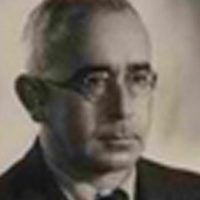
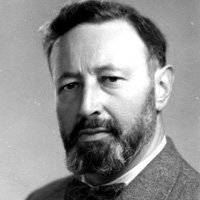

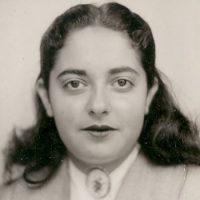
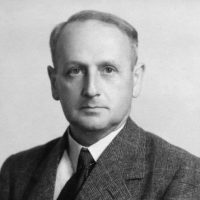
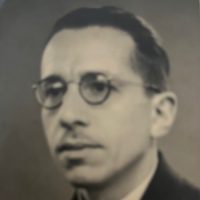
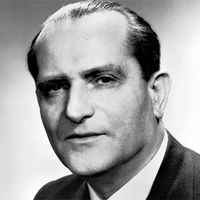
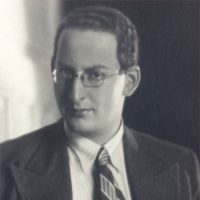
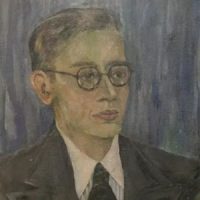

The pharmacist Sigmund Berger was one of many Austrians who believed they were safe from persecution in Great Britain. But Winston Churchill and his government defamed Jews and political refugees as a potential “fifth column” for Hitler. Tens of thousands were interned. Among the more than 2,500 men deported to Australia on the Dunera in 1940 was Sigmund Berger. After two and a half years in Australia, he seized the opportunity to return to England. His ship, the Waroonga, was sunk shortly before reaching its destination. Sigmund Berger could not be rescued. This piece is based on three articles written by Martin Daxner about his grandfather, Sigmund Berger, and his family’s history.
Peter Dehn, September 2026.
A global search for clues
In 1940, Mag. Sigmund Berger, a former pharmacist from Ebensee, sends the lines shown right on a postcard from England to his future son-in-law, Fritz Pollak, who had already successfully emigrated to the United States.
But how did this come about?
Vienna
Sigmund Berger is born on December 18, 1885, in Vienna (Landstrasse, 3rd District, Barichgasse) as the eighth and youngest child of Michael and Leonore Berger. His father is a teacher at the elementary school and for the the deaf and mute at the Jewish Institute for the Deaf and Mute[1] Das Vaterland, September 10, 1872, page 2. in Vienna. Not much is known about Sigmund’s childhood and youth. Aside from a few report cards and photos, there are no documents. These show that after elementary school, he attends the k.k. State Gymnasium[2] Copies of school report cards, ZME/MD. in Vienna’s 3rd District.
On July 15, 1907, he complets his studies in pharmacy in Vienna and, beginning in 1912, runs the “z. Salvator[3] Pharmaceutischer Almanach 1913, Directory Section, page 45.” pharmacy on Zimmermannsplatz in Vienna’s ninth district as an independent pharmacist.
Dear Mr. Engineer, warm regards!
Besides Venezuela, Siam is now a strong contender, because—apart from China, which is out of the question—it’s the only country without a visa requirement. After all, it’s so uncertain whether the application to the Venezuelan government, which the consul is handling for me, will be approved. At the Society of Friends, I was told that no country is issuing visas at all right now—what a lovely state of affairs! But one mustn’t believe everything and must keep fighting. I’m truly glad that at least you are doing well. Warm regards and many thanks for your tireless work on our behalf!
Yours sincerely, Sigmund Berger

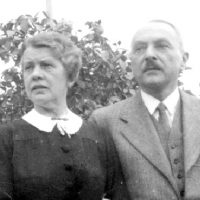
The newlyweds Sigmund and Rosa Berger. Source: Daxner archive.
On October 15, 1907, he leaves Judaism[4] IKG Vienna Registers, Birth Certificates 1882–1886, Entry 1959, Sigmund Berger via FamilySearch. and baptizes in 1909[5] Marriage Certificate, ZME/MD.. One of the reasons may have been his relationship with Rosa Brückner, whom he married on April 27, 1910. He subsequently practices Catholicism with great conviction. Sigmund is “tolerated rather than welcomed with open arms” by the Brückner family because of his Jewish heritage, according to his grandson Martin Daxner.
On January 11, 1911, Eleonore “Lore” Berger is born. On March 20, 1912, Paula Berger, the second daughter, sees the light of the day. She would later emigrate to America via England and help Sigmund Berger escape Austria.
Ebensee
At the end of 1918, the Berger family moves from Vienna to Ebensee on Lake Traunsee to take over the Schutzengel (Guarding Angel) Pharmacy. He finances the purchase with a loan from relatives, and it took 18 years to finally pay off the debt. In 1933, he expands the pharmacy to include a drugstore, which he names after the Höllengebirge[6] Letter from Eleonore Sedlacek, April 22, 1947, in the M. Daxner Private Archive. in the immediate vicinity. Immediately after the end of World War I, it was certainly not the easiest time to take the leap into self-employment. Despite economic uncertainty and debts with exorbitant interest rates, Sigmund Berger devotes himself to social causes with great dedication.
There are documents, photos, and souvenirs from trips to Lake Garda, Mount Etna, Jerusalem, Versailles, Dalmatia, and other destinations. His daughters, now in their teens, also share this passion for travel, and during language study abroad programs, Paula is later able to forge vital contacts in England.
His greatest passion, without a doubt, is chess. Thanks in no small part to Sigmund Berger, the Ebensee Chess Club becomes one of the most important in Austria. Two major tournaments featuring international chess grandmasters are organized primarily through his initiative. As a result, he is also named an honorary member of the Upper Austrian Chess Association. Local and international newspapers, as well as radio stations, report on the chess events in Ebensee. In his opening speech[7] Chronicle of the Ebensee Chess Club, ZME., Sigmund Berger explains that “there has never been a tournament of such significance in the Austrian provinces.”
Supporting a wide variety of charitable events or personal emergencies is just as much a matter of course as providing daily meals for poor workers’ children at the family’s lunch table.

Sigmund Berger (left) at the chessboard. Source: Daxner archive.
On January 13, 1927, Annemarie Berger—the author’s mother—is born as the youngest child. As is customary in middle-class families at the time, her older sisters are already attending boarding schools for older students. Lore studies pharmacy (after the war, in 1947, she would take over the license for the Schutzengel Pharmacy in Ebensee). She enjoys Vienna’s cultural life to the fullest. Through friends, she gains access to Vienna’s major cultural salons, where she meets many interesting personalities.
In 1937 Lore Berger marries[8] Curriculum Vitae of Eleonore Sedlacek, ZME/MD. Alfred Wieser, who would go on to play a tragic role in this story. Also in 1937, the debts from the purchase of the pharmacy are finally paid off. The Berger family is able to afford an alpine hut on the Postalm as a retreat, since Sigmund Berger is also very close to nature, as evidenced by numerous photographs of mountain hikes as well as chess games played outdoors.
Not least because of his social commitment, Mag. Berger is a highly respected member of the community.
Chased, beaten, arrested
The “Anschluss[9] dunera.de: Wikipedia entry on the “Anschluss” of Austria, accessed on August 20, 2025.” of Austria on March 13, 1938, brings an end to the middle-class, tranquil life in Ebensee. Severe abuse and humiliation begins immediately. Sigmund Berger is brutally assaulted by several SA members in front of his pharmacy, afterward, he is denied any medical care (the doctor’s alleged comment: “This man is just faking it”). In his despair, Mag. Berger attempted suicide with morphine, but to the Nazis’ regret, the attempt failed.
Rosa Berger[10] Archive MD. writes a complaint to Gauleiter Josef Bürckel in July 1938, reporting:

Humiliation as a Principle: Shortly after the “Anschluss” of Austria in March 1938, the Nazis forced Viennese Jews to clean the sidewalks. Source: Wikipedia (German), public domain.
“On the night of March 16–17, 1938, while my husband was working at the pharmacy, he was attacked by two men in uniform, severely beaten for an hour, kicked, and beaten with chairs and paperweights so violently that three of his teeth were knocked out. In addition, they demanded that he pay the sum of 2,000 schillings. They also took goods without paying for them. The perpetrators did not leave until Miro Dufek, a Party member who lived in the house, arrived. […] The next morning, at the request of the mayor of Ebensee, my husband was forced to make a donation of S 2,000 for the benefit of the town’s poor. […] The events of that night had such a profound effect on my husband’s state of mind that he attempted suicide that morning and was admitted to the hospital in Bad Ischl in a state of severe unconsciousness, where he was brought back to life only through the extraordinary dedication of the doctors.”
The Nazi press[11] Linzer Volksblatt, March 17, 1938, page 8., which was brought into line with the regime, on the other hand, portrays Berger as the perpetrator:
“Sigmund Berger, a pharmacist in Ebensee and a baptized Jew, had recently had an altercation in his store with a German Reich police officer. As punishment, he was fined. On Wednesday, the 16th of this month, at noon, he was to be arrested and taken away. Berger, however, wanted to preempt this, which is why he ingested poison. The Ebensee Rescue Society transported him, in serious condition, to the General Hospital in Bad Ischl.”
As a result, normal business operations are made nearly impossible by constant harassment. Her daughter Paula decides to emigrate immediately, and her old contacts in England prove very helpful. She arrives in England in early summer 1938, and from there travels to New York on February 11, 1941. Seven days later, she marries Fritz Pollak[12] Martin Daxner, Notes on the Biographies, Nov. 30, 2023, ZME. (now Fred Polk).
“Preventive detention”
Now things come thick and fast: On June 22, 1938, Sigmund Berger is taken into so-called “protective custody” and transferred to Linz. At the same time, a “wild” Aryanization of the Schutzengel Pharmacy takes place without any legal basis. Mag. Hans Ledwinka, the leaseholder of the Altheim Pharmacy, drives Rosa Berger out of the pharmacy and from then on runs the business without any authorization. Confident that his good connections would secure him the pharmacy license, he simultaneously terrorized Sigmund Berger in prison, demanding that he finally sign the contracts—otherwise, he would ensure that Berger was sent to Dachau. After his release, Sigmund Berger is able to move to Vienna to arrange his emigration from there.
The SA Ebensee Standard Command continues to threaten Rosa Berger[13] Undated letter from the SA, ZME/MD..
“You have had sufficient time to settle your business affairs and are now tired of watching your chaotic activities continue any longer. You are therefore ordered to leave Ebensee as soon as possible and not to show your face in the town again.“
As a result, the Bergers formally divorce so that the “Aryan” wife might have even the slightest chance of saving any portion of their assets.

A view inside the Schutzengel Pharmacy. Source: Daxner archive.
Rosa Berger is under surveillance by the Gestapo because she is not allowed to have any contact with her “ex-husband.” Nevertheless, she refuses to let this stop her from helping Jewish acquaintances and repeatedly taking in so-called “U-boats” (Jews trying to evade persecution).
The Pharmacy Robbery
After tough negotiations, it was not Mag. Ledwinka but Mag. Degenberger[14] Ellmauer, Daniela/John, Michael/Thumser, Regina: “Arisierungen,” Confiscated Assets, Restitution, and Compensation in Upper Austria, Vienna 2004, p. 245.—a former underground Nazi and close friend of Gauleiter Eigruber—who received approval for the license on December 8, 1938.
It was not until April 1, 1939, that Degenberger actually received the license for the Schutzengel Pharmacy. Until then, the family did not know whether they would actually receive any money, how much they would get, or what their future livelihood would look like. But constant pressure was being applied to finally pick up the furniture in Ebensee and to stop loitering around Ebensee. The purchase price—only 70% instead of the usual 200% of annual sales—was not transferred until 1941.
Escape, Internment, Deportation
At the same time, his daughter Paula does everything she can to make their departure possible. All we know is that Sigmund Berger manages to escape on February 27, 1939, by leaving from Westbahnhof, and that, after numerous other stops in England, he settles in the village of Radnage, Wycombe, Buckinghamshire.
Finally, on September 3, 1939, with the British declaration of war on Germany, the next blow strucks: All Germans and Austrians in England are declared potential enemies of the state (“enemy aliens”); Sigmund Berger is arrested on September 5, 1939. He and his daughter Paula are interned in various camps on the Isle of Man, a remote island in the Irish Sea. Prime Minister Winston Churchill is aware of the potential injustice but believes that there are more important matters than distinguishing between refugees and actual enemies in this situation.

The HMT Dunera became the ship of doom for 2,500 men deported by the British government. Source: Australian War Museum No. 303219 (Public Domain).
Furthermore, it is decided to ship internees overseas, as England has other concerns than providing for additional civilians. The second transport to Canada aboard the Arandora Star is sunk in the Irish Sea; hundreds of internees drown, and the survivors are assigned to the already overcrowded fifth transport: the military transport ship Dunera. Sigmund Berger is also on the Dunera, believing he is being taken to Canada. Instead of the authorized 1,600 people, there are more than 2,500 on board (including 450 “genuine” prisoners of war). The ship sets sail from Liverpool on July 10, 1940. But as the weather grows increasingly hot, it soon becomes clear that it is not heading for Canada, but southward.
At the camp and as a soldier in Australia

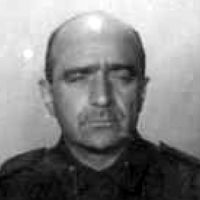
Sigmund Berger—drawn in 1942 at the Tatura camp in Australia by his compatriot Robert Hofmann. Owned by Martin Daxner.
After a 57-day voyage at sea under indescribably harrowing conditions, the Dunera docks in Fremantle on the west coast of Australia on August 27, 1940. On September 6, 1940, the journey finally comes to an end in Sydney. The Australian authorities had been notified of a ship full of prisoners of war, and accordingly, a spartan camp in the desert near Hay (Camp 8) had been prepared. There was great bewilderment and surprise when, instead, primarily harmless civilians disembarked. The result was a global scandal that went down in history as “The Dunera Scandal.” For this reason, the Dunera was the last such transport and the only one to Australia. The Hay camp is closed in May 1941, and the internees are transferred further south to a camp near Tatura, close to Melbourne.
The harmlessness of the “Duneraboys” is obvious, yet it is not until January 1942 that they are initially assigned as harvest workers[15] dunera.de: Quoted from Bartrop, “Enemy Aliens,” op. cit., p. 139. in the extremely fertile region. Subsequently, they were able to enlist as volunteers[16] dunera.de: See memorandum from the Adjutant General to the Australian Parliament, March 29, 1946. NAA_ItemNumber4938132, page 28, section d. in the Australian Army without having to bear arms, which is what Sigmund Berger did. This makes him a free man. After completing his service in December 1942, he is able to move to Melbourne.
Destination USA
There are numerous letters from his time in Australia—all subject to strict censorship rules and written in excellent English—which he writes primarily to his future, and later actual, son-in-law, Fritz Pollak. One senses the unease of a man who had been generous all his life, now having to beg someone else for pocket money ($5 a month) and other favors. But Fritz is the only acquaintance who can obtain the coveted affidavit (a guarantee for entry into the U.S.) for him, which he ultimately succeeds in doing.
In Austria, England, and the US

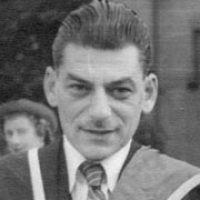
Sigmund Berger in the uniform of the 8th Australian Employment Company. Source: Daxner archive.
Today, communication knows no bounds. Back then, communication takes place through letters; in exceptional cases, by telephone or telegram. Moreover, war and censorship prevail, and there were virtually no means of communication with enemy nations. Many of the letters get lost when the mail ships are sunk and never reach their destination. Communication is therefore very sporadic.
Sigmund Berger is forced to leave his wife Rosa—from whom he is formally divorced—behind in Vienna, destitute, without a home or any chance of employment, along with their minor daughter Annemarie, who is denied a proper education at the high school. With the constant deportations in their neighborhood fresh in their minds, there is a perpetual fear of further reprisals by the authorities. The family’s livelihood is provided by their eldest daughter, Eleonore, who is able to complete her studies in pharmacy just in time before the Anschluss. It is only because of the labor shortage (in Vienna alone, 97!! pharmacies were “aryanized”) that she, as a “half-Jew,” is able to practice her profession. In other academic professions, “half-Jews” are generally barred from employment. Yet she, too, is subjected to constant harassment because of her heritage.
Because on September 1, 1939, at the Westend Pharmacy, she allegedly criticizes, among other things, Adolf Hitler and specifically his foreign policy plans in front of a customer, she is arrested by the Gestapo[17] Indictment dated December 14, 1939, and Eleonore Wieser’s release certificate dated July 10, 1940, MD. on the same day and detained until September 23, 1939. This is followed by her indictment before the Special Court of the Vienna Regional Court and a sentence of six months’ imprisonment, which she serves at Regional Court Prison I in the eighth district. On July 10, 1940, she is released from custody. Alfred Wieser, Lore’s husband, separates from her for reasons unknown to us and emigrates to England.
The Tragic Ending
Up to that point, the family is largely familiar with their grandfather’s fate. However, from his departure from Melbourne to his tragic death in the North Atlantic, various estates reveal a story that is initially completely unclear, with numerous inconsistencies that Martin Daxner has to piece together like a mosaic over many years. It is also helpful that he was able to meet some of the “Duneraboys” in person.
How did the Australian portrait sketch of his grandfather end up in Austria? How could the Red Cross claim that he had perished in the Atlantic in 1942, even though a postcard from Australia was sent as late as the end of 1942? Why did his grandfather meet Aunt Paula in New York without going ashore, even though he had a valid entry permit? Some of these are contradictions that don’t make sense and only become clear with the discovery of Sigmund Berger’s farewell letter:

Sigmund Berger’s last letter to his daughter Paula reveals his fear (or premonition?) of dying on the trip to England. Source: Daxner archive.
“Don’t import a racial problem”
In 1901, Australia had enacted the racist “White Australia Policy[18] dunera.de: A brief overview of the “White Australia Policy” from the National Museum of Australia. Retrieved May 20, 2026.” into law.
At the Evian Conference[19] dunera.de: Wikipedia entry on the Evian Conference, accessed November 10, 2024. in 1938, Minister of Trade Thomas White[20] dunera.de: John Rickard, “Australian Dictionary of Biography,” on Thomas White, cited in Joseph Toltz, “Loss, trials and compassion: music of Australia's Jewish refugees,” University of Sydney online, accessed December 10, 2024. had outlined Australia’s position on accepting refugees: “Since we have no real racial problem, we are not willing to import one.” Prime Minister Lyons[21] dunera.de: Quote from an election campaign speech by Joseph Lyons on September 28, 1937. had declared during the previous election campaign: “Our population is 99.1% of British nationality and we wish to keep it so”.
As a result of this racist stance, Australia refused to accept former internees. Releases from internment must therefore take place on British soil, the government demanded, in order to prevent them from remaining in the country. For many internees, the path to freedom thus led first to England. Those who wanted to go to the U.S., Palestine, or another country had to undertake a second perilous sea voyage. This was true even when—as in the case of Sigmund Berger—U.S. ports were called at on the way to England.
This did not change until Australia was directly threatened by the Japanese bombing of Darwin[22] dunera.de: Wikipedia on theJapanese air raids on Australia, accessed on August 25, 2025. in February 1942. The government[23] dunera.de: Quoted from June Factor, *Soldiers and Aliens*, Melbourne 2022, ISBN 9780522878585, p. 34. now decided “that every person in this country is now—whether he or she likes it or not—in the service of the government to work in the defense of Australia…” For the specially created Army Work Units, internees and other “enemy aliens” were good enough.
(dunera.de)
With the help of his son-in-law Fritz Pollak, Sigmund Berger does indeed obtain the “affidavit”—the entry permit to the United States. On January 29, 1943, he leaves Australia aboard the Waroonga. He travels across the Pacific and through the Panama Canal to New York. There, he is able to speak with his daughter Paula for half an hour and presumably also give her the portrait sketch. But what drives him to continue his perilous journey to England? In his farewell letter[24] Excerpts from the last letter, January 1943, Melbourne, MD., which was forwarded to Paula from Australia after his death, Sigmund Berger writes—out of a paternal, but likely also religiously motivated, sense of duty, though without any real knowledge of the circumstances—that he intends to speak with Alfred Wieser in England in an effort to save his daughter Lore’s marriage after all. For the devout Catholic and prudent father, this is apparently a necessary duty.
“Just for the sake of an interview with Fredl—which I may not even get—I’m heading to the coast regardless of the risk, which is now greater than ever. […] For God’s sake, don’t label me a hero because of this. I’m doing no more than any wild animal would do to fight for its young. […] This letter will reach you through the kindness of my friends, Mrs. Grete and Alfred Landers […] should I perish on this journey. […] And so I bid farewell to you, my dear child. Without empty words, with a single request: Have a Mass said for me every December 18th—and if you can bring yourself to say an Our Father for my poor soul now and then, so much the better. After the war, write to them in Vienna and tell them how everything happened. As I already did on that March 16, I once again ask everyone most sincerely for forgiveness for the many, many bitter hours I have caused you. […]
Stay happy, my children
Your father”
On April 4, 1943, the HX 231 convoy is attacked by German submarines, and the Waroonga is severely damaged by a torpedo strike from U-635. The lifeboat carrying Sigmund Berger capsizes as it is being lowered, and six of the eleven people on board, including Sigmund Berger, drown off the coast of Greenland.
Eleonore, their daughter, keeps the news of Sigmund Berger’s death secret[25] Martin Daxner, Notes on the Biographies, Nov. 30, 2023, ZME/MD. from her mother until the fall of 1944 so as not to worsen her health.
The family’s extensive correspondence across three continents—Europe, the U.S., and Australia—provides insight into the lives of family members separated from one another. The correspondence between Sigmund Berger and his son-in-law Fritz Pollak, for example, focuses primarily on the difficulties and obstacles involved in obtaining an affidavit for Sigmund Berger. Censorship must also be circumvented, which is why Eleonore’s detention, for instance, is described as an “illness” from which she is slowly recovering.

Six of eleven internees were among the victims of the torpedo attack on the Waroonga[26] dunera.de: Collection list for the Hororata/Waroonga, National Library of New Zealand, accessed March 16, 2025.. Built in 1914, the 9,365 GRT ship sailed for the British India Steam Navigation Company on the route from Sydney through the Panama Canal via New York to Liverpool. It was 161.5 meters long and reached a top speed of 13.5 knots[27] dunera.de: U-boat Wiki entry on the Waroonga, accessed on March 20, 2025. (25 km/h). Photo: State Library of New South Wales.
The Battle for the Pharmacy
Mag. Degenberger is arrested when American troops entered Ebensee and is interned at the Glasenbach[28] dunera.de: Wikipedia (German) on the Glasenbach Camp (actually: Camp Marcus W. Orr). From 1945 onward, it served as a U.S. Army camp for high-ranking Nazis. Among them were Stangl, the former SS commander of the Sobibor extermination camp; Burger, the commander of the Warsaw Ghetto; the rectors of the Vienna University of Technology and the University of Vienna; Field Marshal Kesselring; and other war criminals. Retrieved June 20, 2026. internment camp. He leaves Austria after his release.
Mag. Eleonore Sedlacek, née Berger, is the first member of the family to return to Ebensee. On March 1, 1946, she is appointed acting and then provisional director of the Schutzengel Pharmacy. It is not until March 25, 1948, that a settlement is reached with the Restitution Commission[29] Provision Comparison Rk 121/47, ZME/MD. in Linz, which also concerns the return of the apartment belonging to the pharmacy. In the early days, Eleonore has the dubious pleasure of sharing the apartment with the Degenberger family.
However, the compensation by no means covers the damage incurred; as in many comparable cases, it is more important to draw a line under the matter. In the specific case of the pharmacy, the restitution is by no means a foregone conclusion and is only possible because Mag. Lore Sedlacek (later Diernesberger)—a pharmacist with all the qualifications required to manage a pharmacy—is among the rightful heirs. If the aggrieved parties are ineligible for a license, the transfer of pharmacies is effectively made impossible.
The youngest daughter, Annemarie, marries Rudolf Daxner, a chemist born in Ebensee, in 1951. They live in Vienna, later in Baden near Vienna, and have three sons together. Shortly before completing her studies, Annemarie drops out due to the birth of her fourth son. Annemarie and Rudolf live in Altmünster into their old age and are blessed with eight grandchildren and eleven great-grandchildren. She dies in Altmünster on January 22, 2022, shortly after her 95th birthday.
The author of this article, Martin Daxner, born in 1958, is a grandson of Sigmund Berger. A trained pharmacist, he ran the Schutzengelapotheke in Ebensee until 2003; the pharmacy is family-owned by Berger’s descendants until then. In addition, he served as a volunteer inspector for the Upper Austrian Chamber of Pharmacists. He is the long-time chairman of the “Zeitgeschichte Museum” association, founded in 1988, which has been developing and operating the Museum of Contemporary History & Concentration Camp Memorial in Ebensee since 2001.

Martin Daxner. Photo: private.
Please note: With the author’s kind permission, dunera.de summarized three articles[30] Articles (German) by Martin Daxner: „Das Leben und Emigrantenschicksal des Ebenseer Apothekers Mag. Sigmund Berger“ (The Life and Fate as an Emigrant of Ebensee Pharmacist Mag. Sigmund Berger, Catholic Private University of Linz); "Arisierung der Schutzengelapotheke und Curriculum des davon betroffenen Apothekers Mag.pharm Sigmund Berger“ (Aryanization of the Schutzengel Pharmacy and Curriculum Vitae of the Affected Pharmacist Mag.pharm Sigmund Berger), Museum of Contemporary History/Ebensee Concentration Camp Memorial; „Sigmund Berger (18.12.1885-4.4.1943, ertrunken im Atlantik)“ (Sigmund Berger (December 18, 1885–April 4, 1943, drowned in the Atlantic Ocean)), ZME. by Martin Daxner. “Das Leben und Emigrantenschicksal des Ebenseer Apothekers Mag. Sigmund Berger” (The Life and Emigrant Fate of Mag. Sigmund Berger, a Pharmacist from Ebensee) was first published by the Katholische Privatuniversität Linz. “Arisierung der Schutzengelapotheke und Curriculum des davon betroffenen Apothekers Mag.pharm Sigmund Berger” (The Aryanization of the Schutzengel Pharmacy and the Curriculum Vitae of the Affected Pharmacist Mag.pharm Sigmund Berger) was published by the Zeitgeschichte Museum/KZ-GEdenkstätte Ebensee (ZME). The biography “Sigmund Berger (18.12.1885-4.4.1943, ertrunken im Atlantik)” (Sigmund Berger (Dec. 18, 1885–Apr. 4, 1943, drowned in the Atlantic)) was also published there. Due to new findings, the text differs in some places from the original publications. We thank Martin Daxner for providing the images. An editorial note in the right-hand column is intended to provide additional information.
Footnotes
Please note: The footnotes were taken from Martin Daxner’s contributions. Materials from his private archive—which are also available in the Ebensee Museum of Contemporary History archive—are cited as ZME/MD; documents from Daxner’s private archive are cited as MD, and those from the museum archive’s collection are cited as ZME. Additional footnotes, created by the dunera.de editorial team, are marked as such and refer to historical sources.
show
- [1]↑Das Vaterland, September 10, 1872, page 2.
- [2]↑Copies of school report cards, ZME/MD.
- [3]↑Pharmaceutischer Almanach 1913, Directory Section, page 45.
- [4]↑IKG Vienna Registers, Birth Certificates 1882–1886, Entry 1959, Sigmund Berger via FamilySearch.
- [5]↑Marriage Certificate, ZME/MD.
- [6]↑Letter from Eleonore Sedlacek, April 22, 1947, in the M. Daxner Private Archive.
- [7]↑Chronicle of the Ebensee Chess Club, ZME.
- [8]↑Curriculum Vitae of Eleonore Sedlacek, ZME/MD.
- [9]↑dunera.de: Wikipedia entry on the “Anschluss” of Austria, accessed on August 20, 2025.
- [10]↑Archive MD.
- [11]↑Linzer Volksblatt, March 17, 1938, page 8.
- [12]↑Martin Daxner, Notes on the Biographies, Nov. 30, 2023, ZME.
- [13]↑Undated letter from the SA, ZME/MD.
- [14]↑Ellmauer, Daniela/John, Michael/Thumser, Regina: “Arisierungen,” Confiscated Assets, Restitution, and Compensation in Upper Austria, Vienna 2004, p. 245.
- [15]↑dunera.de: Quoted from Bartrop, “Enemy Aliens,” op. cit., p. 139.
- [16]↑dunera.de: See memorandum from the Adjutant General to the Australian Parliament, March 29, 1946. NAA_ItemNumber4938132, page 28, section d.
- [17]↑Indictment dated December 14, 1939, and Eleonore Wieser’s release certificate dated July 10, 1940, MD.
- [18]↑dunera.de: A brief overview of the “White Australia Policy” from the National Museum of Australia. Retrieved May 20, 2026.
- [19]↑dunera.de: Wikipedia entry on the Evian Conference, accessed November 10, 2024.
- [20]↑dunera.de: John Rickard, “Australian Dictionary of Biography,” on Thomas White, cited in Joseph Toltz, “Loss, trials and compassion: music of Australia's Jewish refugees,” University of Sydney online, accessed December 10, 2024.
- [21]↑dunera.de: Quote from an election campaign speech by Joseph Lyons on September 28, 1937.
- [22]↑dunera.de: Wikipedia on theJapanese air raids on Australia, accessed on August 25, 2025.
- [23]↑dunera.de: Quoted from June Factor, *Soldiers and Aliens*, Melbourne 2022, ISBN 9780522878585, p. 34.
- [24]↑Excerpts from the last letter, January 1943, Melbourne, MD.
- [25]↑Martin Daxner, Notes on the Biographies, Nov. 30, 2023, ZME/MD.
- [26]↑dunera.de: Collection list for the Hororata/Waroonga, National Library of New Zealand, accessed March 16, 2025.
- [27]↑dunera.de: U-boat Wiki entry on the Waroonga, accessed on March 20, 2025.
- [28]↑dunera.de: Wikipedia (German) on the Glasenbach Camp (actually: Camp Marcus W. Orr). From 1945 onward, it served as a U.S. Army camp for high-ranking Nazis. Among them were Stangl, the former SS commander of the Sobibor extermination camp; Burger, the commander of the Warsaw Ghetto; the rectors of the Vienna University of Technology and the University of Vienna; Field Marshal Kesselring; and other war criminals. Retrieved June 20, 2026.
- [29]↑Provision Comparison Rk 121/47, ZME/MD.
- [30]↑Articles (German) by Martin Daxner: „Das Leben und Emigrantenschicksal des Ebenseer Apothekers Mag. Sigmund Berger“ (The Life and Fate as an Emigrant of Ebensee Pharmacist Mag. Sigmund Berger, Catholic Private University of Linz); "Arisierung der Schutzengelapotheke und Curriculum des davon betroffenen Apothekers Mag.pharm Sigmund Berger“ (Aryanization of the Schutzengel Pharmacy and Curriculum Vitae of the Affected Pharmacist Mag.pharm Sigmund Berger), Museum of Contemporary History/Ebensee Concentration Camp Memorial; „Sigmund Berger (18.12.1885-4.4.1943, ertrunken im Atlantik)“ (Sigmund Berger (December 18, 1885–April 4, 1943, drowned in the Atlantic Ocean)), ZME.
