
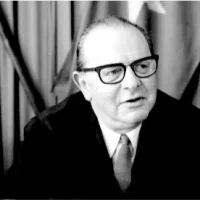

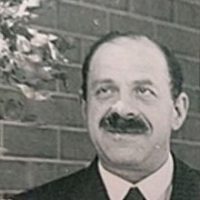
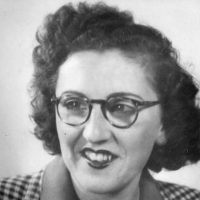
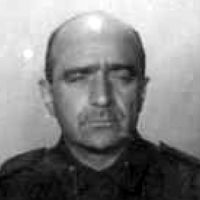
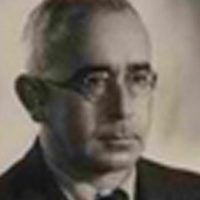
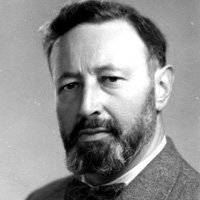

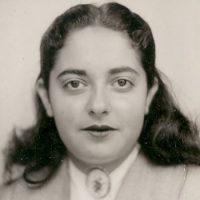
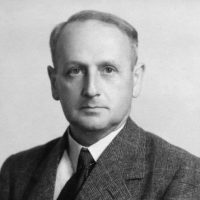
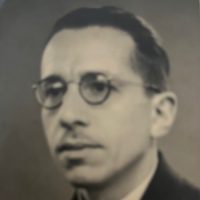
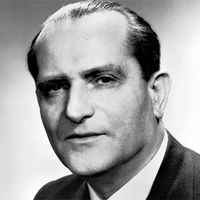
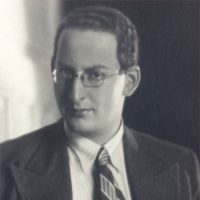
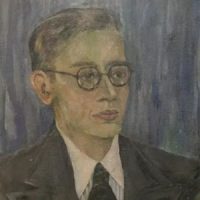
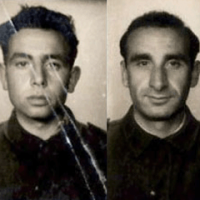

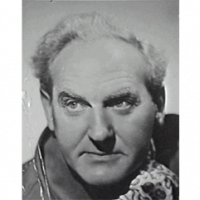
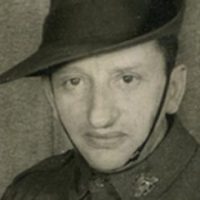
Faced with the destruction of his livelihood and his family being torn apart, Georg Chodziesner fled to Great Britain to escape persecution by the Nazis. His time in the Kitchener Camp transit camp and the Ramsay camp on the Isle of Man overlapped with the stay there of many other refugees from Germany and Austria, who were imprisoned behind barbed wire by the British. The decisive stage was the deportation to Australia on the HMT Dunera. Like many other Dunera Boys, Georg decided to stay in Australia after the war.
Peter Dehn, January 2025.

The last joint photo of the Chodziesner family was taken in Falkensee near Berlin in 1937. Standing from left to right: Georg, his sister Gertrud Kolmar, brother-in-law Peter Wenzel, sister Margot. Seated from left to right: Georg’s sister Hilde Wenzel and her daughter Sabine, father Ludwig, Georg’s wife Thea with son Wolfgang Benno. Courtesy of the Chodziesner family.
As an engineer in Berlin
Georg Friedrich Wilhelm Chodziesner was born in Berlin on March 4, 1900. His father Ludwig was a well-known lawyer and notary in Berlin. He had four children with his wife Elise, who also came from a wealthy Jewish family. The third and only son was Georg. In 1899, the family moved to the upper middle-class Westend[1] Westend was incorporated into Greater Berlin in 1920 as part of Charlottenburg and is now a part in the district of Charlottenburg-Wilmersdorf. district, then a suburb of Charlottenburg.
After leaving school and serving briefly in the army, Georg studied at the Technische Hochschule[2] Since 1946: Technische Universität Berlin. in Berlin[3] Cf. Mapping the Lives about Georg Chodziesner, retrieved Aug 30, 2024. from January 29, 1919 (matriculation number 25950), graduating with a degree in engineering[4] Matrikel, archives of Technical University, vol. VII 1914-1923 (stock 007, signatur), p. 163. on July 24, 1923. From 1929, he developed telegraphy technologies for C. Lorenz AG[5] C. Lorenz AG was founded 1880 and and was a pioneer in radio and telegraphy. A long legal dispute with the market leader Telefunken ended with the takeover by the US company ITT. During the Nazi era, Lorenz developed radio technology for the Luftwaffe, among other things. The company's last name was Alcatel SEL. The brand was dropped after the takeover by Nokia in 2016. See Wikipedia about Lorenz. Cf. Wikipedia about Lorenz (German), retrieved Auf 20,2024. in Berlin, which were later patented[6] Georg Chodziesner is named as (co-)inventor in five patents applied for by Lorenz (DE595297C, DE529975C, DE529976C, DE579887C, DE519068C). Retrieved on Aug 28, 2024 via www.myheritage.de. for the company. Lorenz confirmed in a reference that he was “mainly engaged in the development of circuitry for telephone and signaling facilities” and at times also worked in the patent office. He left due to the takeover by the Berlin branch of the US company ITT.

Georg Chodziesner left behind a diary about the Dunera’s journey that is as personal as it is haunting. Australian historian Seumas Spark describes the 17-page document as “probably the most important and comprehensive account” of the horrific voyage.
In 1931, his new employer confirmed his expertise in the development of antennas, wireless navigation, telegraphy and telex technologies as well as in matters of patent law[7] Cf. excerpt from an English translation of an employee reference, via entries for Georg Chodziesner at www.myheritage.de, retrieved on Aug 28, 2024. The comment on patent law already hints at Georg’s later focus of work.
Firmly established in his profession, he married Dorothea “Thea” Galliner (*October 29, 1904), a lawyer[8] Cf. Mapping the Lives names the educational path “Jur. Landesprüfungsamt” (Legal State Examination Office) for Dorothea Chodziesner, retrieved on 30.8.2024. and daughter of the liberal rabbi Julius Galliner, on June 21, 1929. Their son Wolfgang Benno[9] George Chodziesner. Biographical Notes. Prepared by Ben Chodziesner, May 18, 2011., known as Ben in the family, was born in Berlin on October 5, 1935.
On the run from the Nazis, deported by the British

Lunch break at Kitchener Camp. Georg Chodziesner on the right, fourth from the front. Source: Kitchener Camp website.
Like his sisters Hilde and Margot, Georg fled abroad to escape Nazi persecution. While Thea and Ben were able to escape to Chile, Georg reached the British Kitchener Camp in August 1939. He worked in the transit camp’s drawing office[10] Index card for Georg Chodziesner from the British Home Office, via ancestry.de, accessed on 30 August 2024.. Like thousands of other refugees and after the usual questioning by a “tribunal”, he was classified as a friendly foreigner in the so-called category “C” on October 19, 1939.
Following a xenophobic campaign by British Nazi sympathizers and the growing fear of a German invasion of Great Britain in May 1940, he was nevertheless treated as an enemy and interned, as were tens of thousands of refugees. He was initially taken to one of the camps on the Isle of Man. On July 10, 1940, together with Heinz Dehn, the paediatricians Dr. Wasser, Dr. Frankenstein and many comrades from the Kitchener camp, he embarked with more than 2,000 refugees on a journey into the unknown on the HMT Dunera, which, after 57 days of horror, took them behind the barbed wire of the Australian desert camp of Hay (state of New South Wales), and in mid-1941 to Tatura (state of Victoria).
British files on Georg Chodziesner’s internment already noted “to be released in Australia” on January 25, 1941[11] It was not until March 1941 that Major Layton, commissioned by the British government to repatriate internees, arrived in Australia.: However, the Australian government refused this to all internees on principle. Because the admission of Jewish refugees was undesirable there at the time, it was demanded that the internees be released on British soil. This was because Australian law applied the racist principle of a “White Australia”. “Our population is 99.1% of British nationality and we wish to keep it so” was, for example, an anti-Semitic election campaign argument used by re-elected Prime Minister Joseph Lyons[12] From a speech by Joseph Lyons on September 28, 1937 during the campaign for his re-election as Prime Minister. in 1937.
It was only when Australia suffered from a significant shortage of labor – due to the mass conscription after Japan’s entry into the war – that the internees were remembered. The Dunera Boys still in the camps were promised the right of residence or citizenship[13] Cf. memorandum of the Attorney-General for the Australian Parliament, March 29, 1946. National Archives of Australia (NAA), NAA_ItemNumber4938132, sheet 28, number d. after military service. Georg was released from internment on September 24, 1942. He joined the 8th Employment Company, which was made up exclusively of Dunera Boys, and served the country as a soldier in this work unit until November 1945.
A new life in Australia
Georg had little contact with his wife Thea and his son Ben in Chile because of the war. On November 6, 1943, Thea died of a heart condition in her exile in Concepción. Georg now set everything in motion to bring Ben to Australia. He was first placed in an orphanage and then hospitalized for diphtheria. Later, family friends[14] George Chodziesner. Biographical Notes, loc.cit. in Santiago took him in. The fact that it took a year and a half for the then nine-year-old to finally arrive in Melbourne[15] Cf. Australian files on Wolfgang Benno Chosziesner, including NAA_ItemNumber9651800 (not digitized). on board the Astoria on May 1, 1945 can also be attributed to the course of the war. As Ben later told[16] Cf. email from Simon Chodziesner to dunera.de dated Aug 30, 2024. his children, despite Japan’s foreseeable defeat, observers were deployed on the Astoria to warn of submarines and other potential attackers during the crossing of the Pacific.

Georg and Thea Chodziesner in Berlin. Flight separated the couple. Courtesy of the Chodziesner family.
After the end of his army service on November 26, 1945, Georg was employed by a telecommunications company owned by T.S. Skillman, who relied on Georg’s experience at Lorenz. Georg again specialized in preparing patent applications in the field of telecommunications and business automation.
Father and son became Australian citizens[17] See naturalization file Georg Chodziesner, NAA_ItemNumber6244579 (not digitized). on February 22, 1946.
In 1960, Georg moved to the patent law firm Arthur S. Cave, with whom he had previously worked as a client. At the same time, he studied law, specializing in patent law. He graduated as a patent attorney in 1965. He worked for Cave as a partner until his retirement.
Hobbies and honorary posts
Georg had remarried in November 1947. His second wife was Susan[18] Cf. email from Simon Chodziesner, loc. cit. (Susanne Ellen) Kareis. Born in Austria in 1903, she had also been naturalized in 1946. She died in 1985.
He used his army discharge money to buy a property in Narraweena, a community north of Sydney. There he had a house built according to his own design, which the family moved into in 1952. The house also provided him with space for his hobbies[19] George Chodziesner. Biographical Notes, loc.cit.. Georg collected classic cars, which he kept in good condition. Among others, he owned a 1932 Austin 7 and a 1947 Vauxhall Tourer. His first new car was a 1955 Peugot 203. He also looked after the garden and traveled Australia with Susan, taking hundreds of photos. He was also interested in classical music.
Georg Chodziesner was also involved in voluntary work: his involvement in a local group concerned with road safety later led to the position of Vice President of the Road Safety Council of the State of New South Wales. He was instrumental in the development of the probationary driver’s license[20] Cf. Wikipedia about driving licenses in Australia, retrieved Aug 30,2024. program in NSW, which was later adopted for the whole of Australia.
Until his death on January 31, 1981, Georg Chodziesner worked part-time for the patent law firm Cave.
George’s son Ben, grandchildren and great-grandchildren

Reunited after years apart. Son Ben and father George.
Courtesy of the Chodziesner family.
A photo of Georg and Ben was taken soon after Ben’s arrival in Melbourne in May 1945. Georg is wearing the uniform of the 8th Employment Company, Ben the uniform of his Melbourne school, and during Georg’s time in the army the boy lived with Fischer at 44 Wellington Street[21] CF. Army files Georg Chodziesner, NAA_ItemNumber6244579. By the way, Heinz Dehn lived at 57 and 109 Wellington St. from 1946 to 1951. in the Windsor district of Melbourne. He later lived with the Lewin family[22] Cf. email from Simon Chodziesner, loc. cit. in the Hawthorne district.
Georg brought Ben there from Melbourne a little later, after he had established himself professionally in Sydney. Ben attended Sydney Technical High School, Paddington. In 1951, his name appeared in a list of outstanding school leavers[23] Cf. email from Simon Chodziesner, loc. cit. at number 1 for the subject German. He also received a scholarship to study at the University of Sydney.
Ben met the British woman Diana Lewis, born on March 18, 1935. They married in Chatham, UK, on August 30, 1958; they moved to Australia in 1960. Like his father, Ben had a degree in engineering, but in chemistry. He worked in the oil and plastics industry for companies such as Exxon, Union Carbide, Australian Synthetic Rubber, Altona Petrochemical Company and Monsanto. He worked mainly in Australia, with professional detours to Hong Kong and Singapore. He retired from work as early as 1995 to provide round-the-clock care at home for Diana, who was seriously ill with Alzheimer’s disease.
Ben also used his experience to become publicly involved in the interests of family caregivers[24] Cf. email from Simon Chodziesner, loc. cit.. First as President of Carers Victoria and later of the national umbrella organization, he was active as an advocate for people caring for their loved ones at home on a voluntary basis.
Ben Chodziesner died on September 16, 2018, leaving behind two sons and a daughter. Thea – named after Ben’s mother – was born in 1961. She is married to Michael and has daughters Kara, Jenna and Alyssa. Simon was born in 1963 and is married to Martina; their children are Madison, Joshua, Jordan and Liam. Paul was born the youngest in 1965. He and his wife Jane have daughters Emily, Jordyn, Anna and Sophie.
All three families live in Melbourne. Paul and Simon are actively involved in the Dunera Boys’ and Queen Mary internees’ remembrance work on the board of the Dunera Association. They also look after the memory of their great-aunt Gertrud Kolmar. In February 2024, Paul was able to receive some books in Berlin that were rescued after the theft of his father’s 3,000-volume library and Gertrud’s possessions and could be assigned to them in the course of provincial research.
About the Chodziesner family
Georges parents Ludwig and Elise
Georg and his sisters come from an interesting family. His father Louis was born on August 28, 1861 in Obersitzko (today Obrzycko, Poland). After leaving school, he went to Berlin to study law. His wife Elise – they had married on )March 22, 1894 – came from the Schoenflies family of factory owners from Landsberg/Warthe. She was born on July 17, 1872 and died in Berlin on March 25, 1930[25] Registry office Falkensee, entry no. 22, of March 26, 1930.. A close relative of Elise’s was the philosopher Walter Benjamin.
George’s father became famous through his representation of Philipp Fürst zu Eulenburg-Hertefeld[26] Wikipedia about the Harden-Eulenburg-affair, retrieved Sep 4, 2024., among others. The aristocrat from Kaiser Wilhelm II’s immediate circle was accused of homosexuality as part of a covert campaign against the Kaiser’s foreign policy.
Louis Chodziesner – like many middle-class people with Jewish roots – perhaps saw himself more as a “German” than as a Jew with the Francophile first name of the “hereditary enemy” of the imperial loyalists[27] Wikipedia about Ludwig Chodziesner, retrieved Aug 18, 2024.? This appears contradictory to the outside world. He signed his marriage certificate to Elise as Louis in 1894, as well as Georg’s birth certificate in 1900. On the occasion of Hilde’s birth in 1906, however, he registered his first name as Ludwig[28] Birth certificates from the Charlottenburg registry office for Georg Chodziesner No. 690 dated March 3, 1900, and Hilde Chodziesner no. 2 dated Jan 2, 1906.. Did he give his son the additional Kaiser first names Friedrich and Wilhelm out of patriotism?

Ludwig Chodziesner ca. 1925. Courtesy of Deutsches Literaturarchiv Marbach.
Justizrat[29] Justizrat (like Councillor of Justice) was an honorary title for lawyers during the imperial era and denoted admission to the higher courts. Cf. Wikipedia, retrieved Sep 1, 2024. Ludwig Chodziesner practiced as a lawyer and notary in Berlin. He was horrified by the threat posed by the Nazis and the racist persecution that began immediately after they seized power. He suffered from being banned from his profession, thrown out of his Westend apartment and the forced sale of his house in Falkensee[30] Falkensee is a western suburb of Berlin in what is now the federal state of Brandenburg.. In 1939, he wrote to his daughter Hilde: “On Friday, I was in a synagogue[31] Sebastian Chosinski “Z Wagrowca do Berlina i Chicago”, quoted by wikipedia about Ludwig Chodziesner, loc.cit. for the first time in 60 years”.
On September 1, 1942, the Gestapo ordered the confiscation of all of Ludwig’s assets. This order was served on him on September 8. Ludwig was deported to Theresienstadt[32] Cf. transport list of the 60th Alterstransport, Holocaust statistics, retrieved on Aug 25, 2024. on September 9, 1942 on the 60th transport for the elderly. He died there on February 13, 1943 at the age of 82. The death certificate notes myodegeneratio condis (inflammation of the heart muscle) and enteritis acuta (intestinal catarrh) as the immediate cause of death[33] Index card Theresienstadt, via Arolsen Archive and death notice Theresienstadt from Feb 13, 1943 via myheritage.de. – clearly a consequence of the prison conditions.
“Main tenant evacuated” – the bureaucracy of the Holocaust

The last bill from the municipal electricity supplier Bewag. Source: Chodziesner files of the Berlin Brandenburg Chief Finance President (Brandenburg State Archive, 36A (II) 5778).
Ludwig Chodziesner and his daughter Gertrud had barely been removed from the “Jewish apartment” in Berlin-Schöneberg, Speyerer Straße 10[34] The part of Speyerer Strasse south of Barbarossastrasse was abandoned in 1958 and rebuilt according to modified plans., when the German Reich came after his assets. The senior bailiff Schimmrigk had estimated Ludwig Chodziesner’s remaining assets in the apartment at zero in November 1942 and charged 2.50 Reichsmark for fees and expenses.
On November 1, 1943, the Schöneberg tax office assessed Georg Chodziesner’s assets[35] All information on the realization of Georg Chodziesner's assets was taken from the restitution file AZ (149 WGK) 1 WGA 514/50 (s31/53). Via Archivportal-D Wiedergutmachung (German), retrieved on 25.2.2024. at 102,305 Reichsmark. At 99,300 Reichsmark, the largest item is a rented house in Berlin-Steglitz, but this is encumbered with a mortgage “for Reich flight tax” of 37,250 RM.
Nevertheless, the apartment had not yet been vacated until March 1943. The remaining furniture etc. was valued at 3,096 Reichsmark and sold to a dealer for 2,485.55 Reichsmark for the benefit of the state treasury. At the end of March 1943, a “bomb-damaged” Mr. Agatz applied for the apartment. He had to sleep in emergency accommodation in the corridor and urgently needed the apartment to “maintain my ability to work”. A few days later, the building owner Eleonore Lenkeit confirms that the “main tenants have been evacuated”. Like the suppliers of gas and electricity, she allegedly demands outstanding rent or fees. The official correspondence ended in June 1944.
Apparently, the son-in-law Peter Wenzel became involved in the proceedings for compensation for Georg and Gertrud Chodziesner in 1950. However, he only received information about the deportation transports of Ludwig and Gertrud. An exchange of letters within the authorities concerning the exchange of files began in October 1953 and ended in May 1979.
The sisters Margot, Hilde and Gertrud
Margot Chodziesner (*January 18, 1897) obtained a doctorate in zoology. She emigrated and arrived in Australia on board the Oronsay in May 1939 and found work on a poultry farm. However, she never had a chance to see her interned brother Georg again. She died in Sydney on June 7, 1942; she was only 45 years old.
Hilde (* December 27, 1905) ran a bookshop with her husband Peter Wenzel (born 1906) and a friend in Grolmanstraße near Berlin’s Kurfürstendamm until her escape. She went to Switzerland with her daughter Sabine (*April 6, 1933). Her husband Peter, who divorced her in 1942, survived in Berlin and achieved the first publication of Gertrud’s works in 1947. He later emigrated to Brazil, where he died in 1961.
Hilde’s daughter Sabine spent most of her professional life traveling on behalf of the UN. After retiring, she settled in the Brazilian coastal town of Paraty, where she died in 2024[36] Cf. email from Simon Chodziesner, loc. cit..

George’s sister Hilde Wenzel and her daughter Sabine. Courtesy of the Chodziesner family.

Gertrud Kolmar, ca. 1928. Courtesy of the German Literature Archive Marbach.
Gertrud Käthe, the eldest of the four Chodziesner children, was born in Berlin on December 10, 1894. She was trained as a language teacher and educator. Her first poems appeared at the end of the 1920s. She became known under her pseudonym Gertrud Kolmar[37] Cf. Wikipedia about Gertrud Kolmar (German), retrieved Aug 18,2024. and is considered one of the most important poets in the German language. Gertrud moved in with her parents in Falkensee to care for her seriously ill mother and relieve her father. After Elise’s death in 1930, she supported her father, even after he was banned from his profession by the Nazis. After the forced sale of the house in Falkensee at the end of 1938, she shared a room with her father in that overcrowded “Jewish apartment” in Speyerer Straße 10.
From 1941, Gertrud did forced labor in an armaments factory. She was arrested at the end of February 1943 as part of the so-called “Fabrikation[38] Wikipedia about the so-called Fabrikaktion, through which the last Jews employed in Berlin armament companies, were deporeted to death camps. This triggered the resistance action by non-Jewish people who protested against the arrests in front of the Berlin assembly point in Rosenstrasse near Alexanderplatz, retrieved Aug 24, 2024.” and deported to the Auschwitz extermination camp on March 2, 1943. Of the 1,500 Jews on this 32nd eastward transport, only 680 were registered by name in the camp itself. The others, including Getrud, were murdered[39] Cf. Wikipedia about Gertrud Kolmar, loc.cit. immediately upon arrival. Gertrud Kolmar is commemorated by Stolpersteine in Falkensee and Berlin-Schöneberg and a memorial plaque in Berlin-Westend.
Ludwig Chodziesner’s family
Georg’s grandfather Julius, born in 1835 in Rogasen (today Rogozno, Poland) was a haberdasher. He was married to Johanna (née Aschheim, on May 15, 1830 in Mieścisko). He died on March 24, 1910 in Berlin, Johanna died on May 28, 1920. They had five children. Like the eldest son Louis, the brothers Max and Siegfried were lawyers
Max, born on November 21, 1869, was included with writers Alfred Döblin, Lion Feuchtwanger, physicist Albert Einstein and others in the list of the 60 most important Jewish people[40] Wikipedia about Ludwig Chodziesner loc.cit. in Berlin in 1931. With his wife Margarethe (née Landsberg, March 3, 1884) he was able to flee to Montevideo (Uruguay), where he died in 1978. Art objects belonging to Max were auctioned off on March 28, 1938 by the auction house “Union”[41] Auction commissions of the „Reichskammer der bildenden Künste“ (chamber of visual arts), Landesleitung Berlin. Provenance research database, retrieved Sep 1, 2024., owned by Leo Spik[42] Leo Spik Kunstversteigerungen e.K. today resides on Kurfürstendamm in Berlin.. The Gestapo tried to gain access to further assets[43] Restitution file Rep 36A 5779, Brandenburgisches Hauptarchiv, via Archivportal Wiedergutmachung, loc.cit. in 1944. The Nazis also appropriated a plot of land in Rüdersdorf.
Siegfried was born on July 18, 1872. He had represented the sex researcher Magnus Hirschfeld (1868-1935) and his Wissenschaftlich-humanitäres Komitee[44] WhK was the first organization in the world to campaign for rights of homosexuals. (Scientific-Humanitarian Committee; WhK in court several times, which was probably a violation of upper middle-class German “decency”. In 1918, he co-founded the Magnus Hirschfeld Foundation[45] Magnus-Hirschfeld-Gesellschaft, biography Siegfried Chodziesner, retrieved Sep 1, 2024. and was a member of its board of trustees until 1924. He and his wife Minnie also escaped to Montevideo, where he died on May 4, 1948. Minnie died there on June 3, 1976.
Georg’s Aunt Rebekka (*24.7.1867 – 30.11.1962) and her husband Alexander Lindenheim (*1869), on the other hand, only managed to emigrate to Uruguay in November 1940. Uncle Albert (*4.9.1864) and his wife Friederike (Rica) née Hertz married on March 19, 1904. Albert died on September 29, 1926, Rica only a few days later on October 11, 1926. Their son Kurt was born in Berlin on April 10, 1905. His fate is not known.
Please note: We would like to thank Thea, Paul, and Simon Chodziesner for their comprehensive support with information about the Chodziesner family and for providing photos from their archive.
Footnotes
show
- [1]↑Westend was incorporated into Greater Berlin in 1920 as part of Charlottenburg and is now a part in the district of Charlottenburg-Wilmersdorf.
- [2]↑Since 1946: Technische Universität Berlin.
- [3]↑Cf. Mapping the Lives about Georg Chodziesner, retrieved Aug 30, 2024.
- [4]↑Matrikel, archives of Technical University, vol. VII 1914-1923 (stock 007, signatur), p. 163.
- [5]↑C. Lorenz AG was founded 1880 and and was a pioneer in radio and telegraphy. A long legal dispute with the market leader Telefunken ended with the takeover by the US company ITT. During the Nazi era, Lorenz developed radio technology for the Luftwaffe, among other things. The company's last name was Alcatel SEL. The brand was dropped after the takeover by Nokia in 2016. See Wikipedia about Lorenz. Cf. Wikipedia about Lorenz (German), retrieved Auf 20,2024.
- [6]↑Georg Chodziesner is named as (co-)inventor in five patents applied for by Lorenz (DE595297C, DE529975C, DE529976C, DE579887C, DE519068C). Retrieved on Aug 28, 2024 via www.myheritage.de.
- [7]↑Cf. excerpt from an English translation of an employee reference, via entries for Georg Chodziesner at www.myheritage.de, retrieved on Aug 28, 2024.
- [8]↑Cf. Mapping the Lives names the educational path “Jur. Landesprüfungsamt” (Legal State Examination Office) for Dorothea Chodziesner, retrieved on 30.8.2024.
- [9]↑George Chodziesner. Biographical Notes. Prepared by Ben Chodziesner, May 18, 2011.
- [10]↑Index card for Georg Chodziesner from the British Home Office, via ancestry.de, accessed on 30 August 2024.
- [11]↑It was not until March 1941 that Major Layton, commissioned by the British government to repatriate internees, arrived in Australia.
- [12]↑From a speech by Joseph Lyons on September 28, 1937 during the campaign for his re-election as Prime Minister.
- [13]↑Cf. memorandum of the Attorney-General for the Australian Parliament, March 29, 1946. National Archives of Australia (NAA), NAA_ItemNumber4938132, sheet 28, number d.
- [14]↑George Chodziesner. Biographical Notes, loc.cit.
- [15]↑Cf. Australian files on Wolfgang Benno Chosziesner, including NAA_ItemNumber9651800 (not digitized).
- [16]↑Cf. email from Simon Chodziesner to dunera.de dated Aug 30, 2024.
- [17]↑See naturalization file Georg Chodziesner, NAA_ItemNumber6244579 (not digitized).
- [18]↑Cf. email from Simon Chodziesner, loc. cit.
- [19]↑George Chodziesner. Biographical Notes, loc.cit.
- [20]↑Cf. Wikipedia about driving licenses in Australia, retrieved Aug 30,2024.
- [21]↑CF. Army files Georg Chodziesner, NAA_ItemNumber6244579. By the way, Heinz Dehn lived at 57 and 109 Wellington St. from 1946 to 1951.
- [22]↑Cf. email from Simon Chodziesner, loc. cit.
- [23]↑Cf. email from Simon Chodziesner, loc. cit.
- [24]↑Cf. email from Simon Chodziesner, loc. cit.
- [25]↑Registry office Falkensee, entry no. 22, of March 26, 1930.
- [26]↑Wikipedia about the Harden-Eulenburg-affair, retrieved Sep 4, 2024.
- [27]↑Wikipedia about Ludwig Chodziesner, retrieved Aug 18, 2024.
- [28]↑Birth certificates from the Charlottenburg registry office for Georg Chodziesner No. 690 dated March 3, 1900, and Hilde Chodziesner no. 2 dated Jan 2, 1906.
- [29]↑Justizrat (like Councillor of Justice) was an honorary title for lawyers during the imperial era and denoted admission to the higher courts. Cf. Wikipedia, retrieved Sep 1, 2024.
- [30]↑Falkensee is a western suburb of Berlin in what is now the federal state of Brandenburg.
- [31]↑Sebastian Chosinski “Z Wagrowca do Berlina i Chicago”, quoted by wikipedia about Ludwig Chodziesner, loc.cit.
- [32]↑Cf. transport list of the 60th Alterstransport, Holocaust statistics, retrieved on Aug 25, 2024.
- [33]↑Index card Theresienstadt, via Arolsen Archive and death notice Theresienstadt from Feb 13, 1943 via myheritage.de.
- [34]↑The part of Speyerer Strasse south of Barbarossastrasse was abandoned in 1958 and rebuilt according to modified plans.
- [35]↑All information on the realization of Georg Chodziesner's assets was taken from the restitution file AZ (149 WGK) 1 WGA 514/50 (s31/53). Via Archivportal-D Wiedergutmachung (German), retrieved on 25.2.2024.
- [36]↑Cf. email from Simon Chodziesner, loc. cit.
- [37]↑Cf. Wikipedia about Gertrud Kolmar (German), retrieved Aug 18,2024.
- [38]↑Wikipedia about the so-called Fabrikaktion, through which the last Jews employed in Berlin armament companies, were deporeted to death camps. This triggered the resistance action by non-Jewish people who protested against the arrests in front of the Berlin assembly point in Rosenstrasse near Alexanderplatz, retrieved Aug 24, 2024.
- [39]↑Cf. Wikipedia about Gertrud Kolmar, loc.cit.
- [40]↑Wikipedia about Ludwig Chodziesner loc.cit.
- [41]↑Auction commissions of the „Reichskammer der bildenden Künste“ (chamber of visual arts), Landesleitung Berlin. Provenance research database, retrieved Sep 1, 2024.
- [42]↑Leo Spik Kunstversteigerungen e.K. today resides on Kurfürstendamm in Berlin.
- [43]↑Restitution file Rep 36A 5779, Brandenburgisches Hauptarchiv, via Archivportal Wiedergutmachung, loc.cit.
- [44]↑WhK was the first organization in the world to campaign for rights of homosexuals.
- [45]↑Magnus-Hirschfeld-Gesellschaft, biography Siegfried Chodziesner, retrieved Sep 1, 2024.
