
During the Second World War, the Australian army conducted trials with new drugs in order to get a grip on malaria, which was particularly rampant in the jungles of the New Guinea theatre of war. Almost 900 soldiers volunteered to help ensure the combat capability of allied units in tropical regions. As far as is known, this is the first time that biographical notes on 13 of the participating soldiers – who had come to Australia as refugees on the Dunera or by other means – are published. The men volunteered for the malaria experiment and were at least able to assess the risks. As anti-fascists, these soldiers saw this as an opportunity to contribute more to the victory over the Axis powers than they could in the 8th Employment Company. And they proudly accepted the risks involved.
Peter Dehn, June 2026.
Guinea pigs in uniform
Under the headline “The Hidden War Experiments”, the Australian daily newspaper “The Age[1] Gary Hughes, Gerard Ryle in "The Age", Melbourne, 19 April 1999. Online on 18 April 2019 under "From the Archives" of "The Sydney Morning Herald", retrieved 28 April 2024.” reported in detail and not without a taste for the sensational on 19 April 1999 about human experiments by the Australian army during and after the Second World War. A few days before ANZAC Day[2] ANZAC Day (Australian and New Zealand Army Corps) commemorates the first joint military action by soldiers from both countries and Tonga in the First World War. They landed on the Turkish peninsula of Gallipoli on 25 April 1915. Among the more than 130,000 casualties on both sides of the nine-month unsuccessful battle for the bridgehead were 8,709 Australians and 2,701 New Zealanders. Cf. Wikipedia (German) on Anzac Day and the Battle of Gallipoli, retrieved 10 May 1924. on 25 April, one of Australia’s most important and patriotic holidays, the paper wrote: “Giant British and United States drug companies profited from the experiments that involved deliberately volunteers with malaria.[3] Wikipedia about Malaria, retrieved 10 May 2024.” In addition to Australian soldiers from the fighting forces, Italian and Jewish internees and convalescents were also successfully recruited.

The description ‘performing a venipuncture’ conceals the fact, that Sergeant Goble was infected with malaria. Source: Australian War Memorial (AWM) No. ART 24300.
Up to 90 per cent of the quinine[4] Wikipedia about quinine, which was known as the only effective remedy against malaria until 1940, retrieved 28 April 2024. that had previously been used to treat malaria was produced in the Dutch colony of Java. After the conquest of this region by Japan in March 1942, this source dried up. The Allies urgently needed an alternative. This was because malaria had at times ravaged Australian soldiers in New Guinea worse than the Japanese, partly due to the lack of medicines and supplies: in 13 weeks of this jungle war to the end of 1942, the army reported 4,137 casualties from combat operations, but at the same time 12,240 deaths due to malaria[5] CF. Wikipedia about Neil Hamilton Fairley (English), retrieved 28 April 2024..
Service for pharmaceutical companies?
Between April 1943 and June 1946, drugs were tested on humans at military bases near Cairns and Rocky Creek (Queensland) under the direction of the LHQ Medical Research Unit. Hospitals in Melbourne and Sydney were later involved. The military officer in charge was Neil Hamilton Fairley[6] Wikipedia about Neil Hamilton Fairley (German), retrieved 12 May 2024. (1891-1966), then Director of Medical Services of the Australian Army with the rank of Colonel.
“Documents indicate that the work was carried out in Australia because America and Britain were reluctant to risk using their own soldiers,” the Australian journalists stated. In the USA, on the other hand, only a small number of prisoners were willing to voluntarily participate in malaria experiments. One of the beneficiaries was the British chemical company ICI, reports “The Age”. The company later patented the results of the experiments and had the drugs produced by the US company Winthrop.

An unnamed employee is feeding larvae in the brood chamber. Source: AWM No. 119049.
Overdose as a test principle?
What has become known about the course of the experiments has been criticised. “Some men were given doses equivalent to being bitten by 13,000 of normally infected mosquitoes,” the journalists from “The Age” took from the documents preserved. “The infections were inflicted by using specially bred mosquitoes or giving men transfusions of up to 800cc of infected blood. One man received 35 doses of infected blood. “

Pte A. Prince was one of the volunteers. Here he feeds mosquitoes with his blood to infect himself with malaria. Source: AWM No. 119086.
“As ‚guinea pigs‘, we had to put our hands in a cage with a light bulb and let mosquitoes bite us,” recalled volunteer Ernst Günther Salomon[7] Interview with Ernst Günther Solomon in "Ein Leben zwischen den Welten" (A life between worlds; German) by Manfred Brusten, Zeitschrift für Australienstudien 11/1997 Seite 81, retrieved 12 May 2024., a Jew who had fled Germany. “As a result, most of us became ill, including me; I even had what is called M.T., the ‚malignant type‘ of malaria, which can be fatal. (…) So we were first infected with malaria and then given Palodrin[8] This certainly refers to the drug Paludrine with the active ingredient proguanil hydrochloride to see if and how it helped.”
Mepacrine[9] Wikipedia about Mecaprin (German), which was developed in Germany in 1930 as a prophylactic against malaria and was marketed as Atebrin or Quinacrine. It is no longer authorised as a drug today. retrieved 28 April 2024. was also one of the active substances tested. The positive effect of this drug, known as Atebrin, had become known through findings in Wehrmacht prisoners, among other things. The human experiments led by Fairley had shown that the soldiers were able to fight even in the highly malarial swamps of New Guinea “as long as the men took their daily tablet of Atebrine[10] "Honor for Guinea Pigs", „The Bairnsdale Advertiser“, 17 January 1947, NLA Trove, retrieved 28 April 2024.“, an Australian provincial newspaper praised him in 1947 and generally praised human experiments.
Rehabilitation patients requested
There was obviously no hesitation in requesting and obtaining volunteers from army rehabilitation centres[11] Cf. Tony Sweeney, "Malaria Frontline: Australian Army research during World War II", Melbourne 2003, ISBN 0522850332, Chapter 21 "Guinea Pigs", pages 223 ff., where the men were to recover from injuries and serious operations such as amputations.
According to an army document, “100 have already been received from rehabilitation centres in south Queensland. A further 200 may be required.” Official documents confirm the use of arm and leg amputees and men with other serious war injuries, according to “The Age”. However, the commander of the unit, Lieutenant Colonel Charles R. Blackburn, complained to the high command that instead of volunteers, “no-hopers[12] Blackburn to Fairley of 6 July 1945, quoted from Sweeney loc.cit., page 224.” were being selected who did not fulfil the requirements of the experiments.
The experiments continued long after the infection had been successfully combated and the infection rate had fallen considerably. According to reports, volunteers were recruited at the end of 1944 with the false claim at the time that Allied soldiers were “dying like flies” from malaria. “Volunteers were still arriving six months after the end of the war”. “The only fear here is that the unit will be disbanded without the Atebrin studies being completed,” complained the Australian officer Fairley in August 1944, not to his superiors but in the USA. There was no reason to do so, as the Australian government authorised tests of the new US drugs for malaria prophylaxis Sontochin and Chloroquine[13] Wikipedia about Chloroqion (German), which had been developed in Germany as well, retrieved 28 April 2024..

Mosquitoes were fed with apples and human blood in the incubator. Source: AWM No. 119062.

Unidentified soldiers prepare blood samples for testing in the biochemistry laboratory. Source: AWM No. 119081.
Disappeared files
“Although partly recorded in official war histories, no mention is made of the use of Jewish refugees, alien internees or disabled soldiers, and details of the work were scattered after 1946. These included personal medical files of soldiers and former internees that Australian authorities later said couldnot be found”, “The Age” reported.
According to the newspaper, however, Fairley had taken extensive medical records to London after the war. Other files were distributed to Australian authorities. Those affected and surviving relatives of the guinea pigs who requested medical records for care applications were told by the authorities that such files could not be found.
Dunera Boys volunteering
Among the guinea pigs who took part in the experiments in Cairns until 1946 were “Jewish refugees, interned in Britain and sent to Australia aboard the Dunera in 1940″, “The Age” journalists revealed.
“The Age” comments on the participation of soldiers from the 8th Employment Company, meaning Dunera Boys: “After being prevented from volunteering for active dut, they were put to work doing menial manual labour in the docks. At least some were used to test a new anti-malarial drug developed by the giant British chemical company ICI.” Among others, the article refers to official documents in which it is doubted that an Italian from another labour unit consisting of ex-internees was taken into the experiment despite insufficient language skills and therefore could not have understood what he was getting into.
Calls in 1944 and 1945
The information used to recruit volunteers from the 8th Employment Company is somewhat ambiguous. A call for volunteers first appears in the Company Routine Order of 31 October 1944[14] Call for “Volunteers for Malaria Experiment” in Company Routine Order No. 47/44 of 31 October 1944, War Diary of the 8th Employment Company, Volume 9, in AWM52 22-1-17-9, page 115.. This “Volunteers for Malarial Experiment” does not contain any detailed information about the experiment or any potential health risks to the participants. It states, among other things, that participation is limited to six months – a detail that is missing from calls for applications published later.
Pte A. Prince was one of the volunteers. Here he feeds mosquitoes with his blood to infect himself with malaria. Source: AWM No. 119086.
The project is described in greater detail on 5 March and 19 July 1945[15] Call for “Volunteers required for malaria experiment” in the Company Routine Orders No. 6/45 of 5 March 1945 and 19 July 1945, War Diary of the 8th Employment Company, Volume 10, in AWM52 22-1-17-10, pages 8 and 112.. The document expressly states that personnel “with physical disabilities” will be accepted, a claim by “The Age” had been confirmed. And risks cannot be ruled out: Volunteers “may be exposed to malaria infections of malignant tertian and/or bening tertian types, while taking antimalarial drugs under close supervision,” is announced. Sick soldiers would only leave the site in Cairns after a full recovery. However, relapses could not be ruled out: “Relapses of benign tertian malaria (the dangerous type) may occur some personnel after rejoining their units.”
About the 8th Australian Employment Company
During the Second World War, the Australian Army maintained 39 labour companies. 15,000 men carried out some of the heaviest war-related work and replaced those who had been drafted into the fighting forces. 11 of these units were made up of men of foreign origin.
The 8th Australian Employment Company (8AEC) consisted exclusively of Jews and Nazi opponents who had been interned by the British as “enemy aliens” and deported to Australia. Anyone who wanted to remain in Australia after the end of the internment or even become a citizen was recommended to volunteer[16] Note from the Adjutant-General to the Australian Parliament, 29 March 1946. National Archives of Australia (NAA), NAA-ItemNumber4938132, page 28, letter d. to an army labour unit. Many of the 500 soldiers of the 8AEC served in Albury and Tocumwal: at the border between the states of Victoria and New South Wales, military and civilian goods had to be transferred between railway wagons of different gauges.
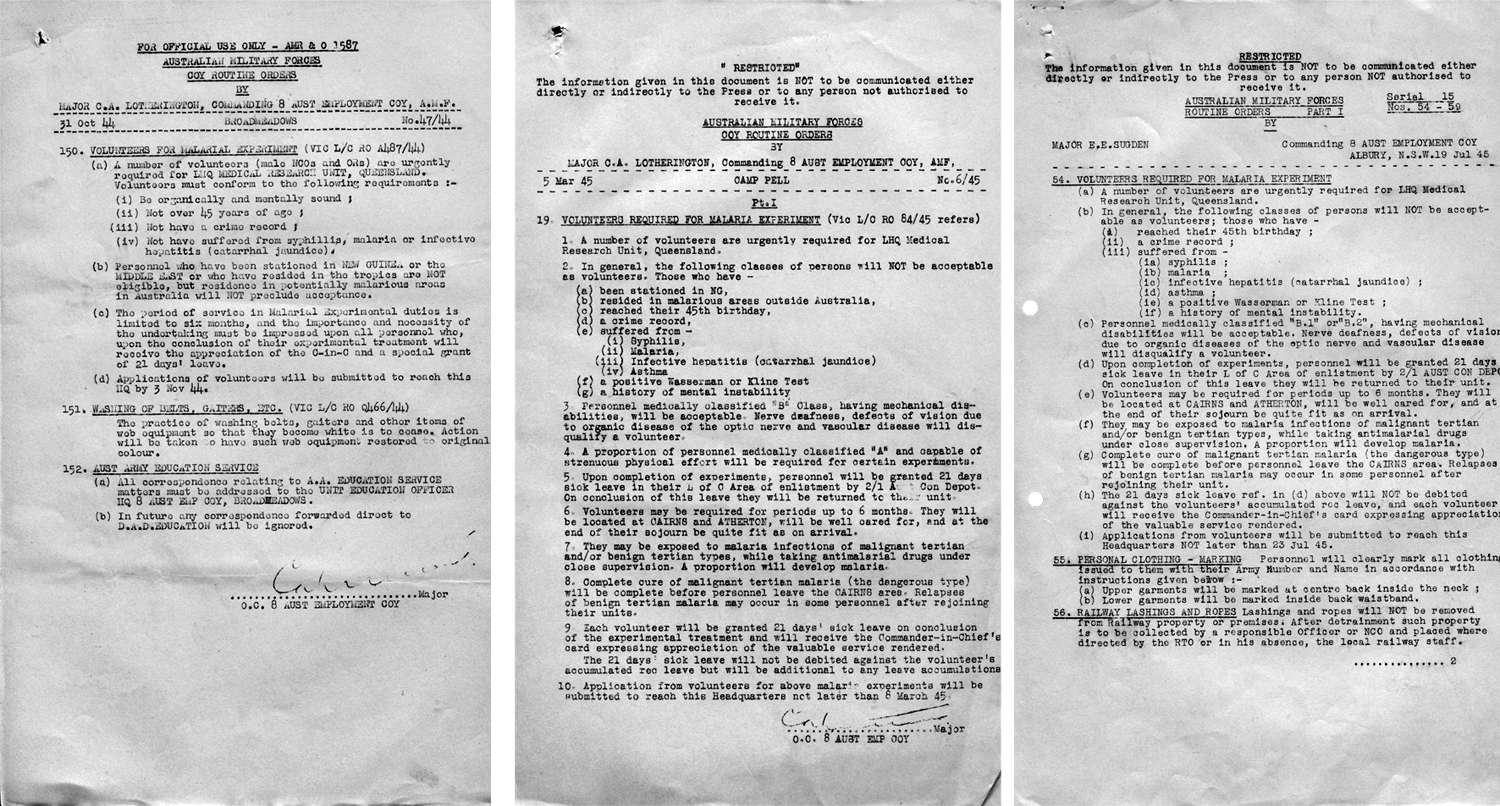
Calls for the malaria experiment in the 8AEC war diary (Click on the image to enlarge). Source: AWM.
As a token of gratitude for their service, 21 days’ special leave and a card with a message of thanks from the Commander-in-Chief for the “valuable service rendered” were promised. The call was repeated once more on 19 July 1945. Nazi Germany had already surrendered, but the fighting against Japan was still ongoing.
The following short biographies of seven Soldiers of the 8th Employment Company and six Jewish refugees is the result of a comparison of the soldiers named by Sweeny as members of the 8AEC and other labour units on the basis of their service numbers with the database of the Australian government’s Department of Veterans‘ Affairs[17] National Government, Department of Veteran’s Affairs, DVA’s Nominal Rolls, retrieved 12 May 2024. (DVA). Where there were matches, the personnel files[18] National Archives of Australia, NAA, record search. of the National Archives of Australia (NAA) were included, provided they were digitised or information could be extracted from the titles. Research on family tree platforms helped to complete some biographies. The photos are from the men’s army files.

‘Atebrin parade’ – Volunteers lined up to receive the drug. Source: AWM No. 119070.
Soldiers of the 8th Employment Company at the malaria experiments

Friedrich Edelhofer (Fred Eden)
The Jewish butcher and slaughterman was born in Vienna on 6 March 1922. Deported by the British on the Dunera, he served in the Australian army from 8 April 1942. In 1943, he received a six-day sentence for absenteeism. He was due to be discharged at the beginning of 1945, but his service was extended and he was seconded to the malaria experiment. Since early in 1947, he was involved several times with the “Murchison PW Group” as a guard in the repatriation of prisoners of war by ship to England. On 10 July 1947, he was discharged from service as a private. He was naturalised in July 1946. He was married to Rebecca and had two children. He died in Melbourne on 28 November 2004.
Ernst Eichengrün (Ernest Edward Green)
The Hamburg Jew, born on 5 September 1923, had begun an apprenticeship as a car mechanic. He celebrated his 17th birthday the day before the Dunera arrived in Sydney. He served in the Eighth from 8 April 1942, sustaining several shoulder and back injuries during his service. From January 1945 he took part in the malaria experiments. The anglicisation of his name was officially confirmed in May 1945. On 7 February 1946, he was discharged from the army with the rank of Lance Corporal. On 14 May 1946, he set sail for the USA on board the Marine Lynx together with Mannheim and Somers. He died in California on 5 December 2004, leaving behind his widow Geraldine, three children and five grandchildren.


Gert (Gerald) Flatau
The Dunera Boy was born in Berlin on 4 November 1923. He did his military service in the 8AEC from 8 April 1942 and was admitted to the malaria experiments on 3 October 1945. He was discharged as a corporal on 1 October 1946. He remained in Queensland, where he was naturalised on 7 January 1946. It is not known when he anglicised his first name to Gerald. He married May Seymour in 1953. They had three children. In Australian electoral rolls, he is registered as a physicist. According to documents from the early 1950s, he worked as a clerk in the technical development department of the Australian Post Office in Melbourne. He died on 9 July 1987.
Walter Manfred Hirsch
He was born on 7 December 1923 in Bergen near Frankfurt am Main, Hesse. His occupation in Australia was upholsterer. He joined the 8AEC on 8 April 1942 and served as a cook. On 20 November 1945 he transferred to the malaria experiment in Queensland. On 6 November 1946 he was discharged from the army as an Private. He became an Australian citizen on 2 September 1947. He died in Melbourne on 4 May 1961, leaving behind his widow Laura Johanna Vandrunick, whom he had only married in 1960.


Hans-Ulrich Hirschberg (Peter John Howard)
Hans was born on 4 November 1922 in Berlin into a family with Jewish roots. He gave his religion as Presbyterian and his profession as hotel employee and waiter. He served in the 8AEC from 8 April 1942 to 8 July 1946 and had his classification as a Jew changed to Presbyterian in his military file in 1944; his name was anglicised shortly afterwards. In May 1945 he enlisted in the malaria unit. A reference to his naturalisation on 22 August 1946, a few days after leaving the service, named Papua/New Guinea as his place of residence. According to his service record, Papua was his last place of deployment when he was discharged on 8 July 1946. On 27 June 1949, he married Ilse Henriette Redlich in Cairns in the north of Queensland. He died on 19 September 2011 in Kingsley, Western Australia, leaving behind his widow and a son.
Hans Walter Knothe
The non-denominational toolmaker was born on 28 December 1921 in Göttingen. After the November pogroms, he was imprisoned in Buchenwald concentration camp from 17 to 25 November 1938 with the prisoner number 25785 and the note “Action Jew” in order to force his short-term departure. He had begun training as an engineer in England. His British Home Office file card bears the note “Not to be interned” dated 3 November 1939. Nevertheless, the 18-year-old was interned on 21 June 1940 and deported to Australia on the Dunera on 10 July 1940. While serving in the Eighth from 8 April 1942 to 31 May 1945, he was punished several times for breaches of discipline. The planned discharge for a job in a Melbourne company for mechanical and electrical products did not materialise at the end of September 1942 for unknown reasons. His transfer to the malaria experiments was authorised at the end of April 1945. He was discharged on 5 August 1946. In April 1947, he was granted permanent residence in Australia. No further details of his life are known.

The volunteer guinea pigs received such certificates, signed by the Commander-in-Chief, as thanks for their ‘valuable contribution’ to the war effort. Source: Military files H. W. Knothe, Australian National Archives, NAA_ItemNumber6255360, page 14.

Alfred Wolff
Alfred was a tanner, born on 2 August 1922 in Dortmund. He was able to escape the Nazis to England, where he was interned and then deported to Australia. At the end of his internment, he enlisted in the army and was assigned to 8AEC. He began his service on 9 April 1942. He was punished several times for bad behaviour and absenteeism from roll call. Like other volunteers, he joined the malaria research unit in January 1945. There, too, he was absent without authorisation on several occasions and was discharged in September 1946. He had applied for naturalisation. The title of an analogous NAA document states: His place of residence was unknown, which is why the naturalisation certificate was confiscated and destroyed on 1 February 1949.
Jewish volunteers from other employment companies
Heinz (Harry) Drucker
Born in Hamburg on 6 September 1920, the Jewish carpenter was imprisoned by the Nazis in Buchenwald concentration camp (prisoner number 28248, “Action Jew”) shortly after the November pogrom until 19 December 1938 and then forced to flee. He reached Australia on 10 February 1939 on the Esquilino. He lived in Queensland and served from 1942 in the 12AEC, taking part in the malaria experiments in Cairns from early August 1945. At the beginning of September 1946 he was discharged as a member of 1 Ordnance Vehicle Park, AAOC. He became an Australian in 1946 and married in 1947, dying on 13 April 1994, leaving his wife Pat and two children. He was a relative of Leon Gottlieb.


Robert Königstein (Kingston)
Robert Königstein was born into a Jewish family in Vienna on 25 August 1910. After his studies, the annexation of Austria by the Nazis and the Jewish pogroms of November 1938, he fled to escape persecution. He reached Melbourne on the Templar on 4 February 1939, having been vouched for by relatives. Shortly afterwards, he anglicised his surname, as they had done in Kingston, to make his break with Germany clear. From June 1939 until the end of 1940 and briefly in 1942, he worked as a teacher of German and French in Melbourne (Victoria) and later in Warwick (Queensland). He was denounced as a potential spy with clearly xenophobic motives because he took photographs on holiday in the Great Barrier Reef and developed the prints himself. He had volunteered for the army in 1942. However, he was initially forced to prove his status as a Jewish refugee in the face of official stupidity and harassment. For example, a police officer in Brisbane rejected his claim to be Austrian born because such a country did not exist and he had (inevitably) presented a German passport. His letter to the Army concludes with the remark that he was eager to serve Australia and had not applied for a new job in order to be available. He was drafted into the 12th Employment Company in February 1942 and from November 1944 was deployed in the malaria experiments in Rocky Creek. He was discharged as a sergeant with the 11 Aust Malaria Control Unit on 6 January 1947. As early as March 1944, he applied for citizenship, for which he received, among other things, a favourable assessment from the army; the official correspondence on this is unusually extensive. In 1948, he applied for the public service in Canberra.
Ernst Günther Salomon
Ernst Günther Fritz Salomon[19] Cf. Interview Ernst Günther Solomon, loc.cit. was born on 7 November 1916 in Swinemünde into an christian officer’s family with Jewish roots. He reached Australia on board the Bremen on 27 December 1938, where his occupation was accountant and finally lathe operator. From 1941, he worked voluntarily in civil defence before being accepted by the 4th Australian Employment Company in September 1943. He extended his service in April 1945 and was initially employed in the 6th Employment Company and from 7 June 1946 until his discharge on 3 September 1946 in the malaria experiments. He was naturalised in April 1945. Together with his fellow malaria trooper Thomas Tibor Gara and others, he founded a meat shop in Adelaide. Their products modelled on European products for the Australian market were a success. By the end of his career, Salomon was export manager of the country’s largest meat factory and a board member of the industry association. For his voluntary work – including the integration of German-speaking migrants and the organisation of student and family exchanges – he was awarded the Order of Merit of the Federal Republic of Germany in 1976. He died on 25 August 2001, leaving behind his wife and three daughters.


Frank Scheiner (Slater)
Frank was born on 13 April 1922 in Kunmadaras (Hungary). It is not known how the Jewish construction worker came to Australia. He served with the 4 Employment Company from 10 March 1942. There he was repeatedly penalised for insubordination and inappropriate language and transferred to the 6AEC. In September 1945 he was confirmed for the malaria experiments. He was discharged in May 1946. By January 1946 his naturalisation had been approved and he anglicised his surname to Slater. In 1949 he was registered as a student on a voters’ roll. He later married and had two children. He died on 30 December 2011.
Ernst Peter Jakob Silberstein
The Jewish laboratory assistant was born in Vienna on July 5, 1920. Nothing is known about his escape from his native Austria to London. From there, he arrived in Australia in December 1938 as a passenger on the Largs Bay. He enlisted in the army and served in the 4th Employment Company beginning July 18, 1942. In September 1944, he was transferred to the 3 Aust Mob Entomological Sec[20] See biography of Major Robert McCulloch by the Roseworthy Campus Association.; this unit conducted research on combating mosquitoes and mites and developed the mite repellent dibutyl phthalate, which, when applied to clothing, reduced cases of bush typhus by 90%. From October 1945, he served—most recently as Staff Sergeant—in the 9th Aust Malaria Control Unit. On June 3, 1944, he became an Australian citizen.


Harry Walter Somers
He was born on 28 May 1922 in Zweibrücken. Nothing is known about his escape from Germany. He served in the 12th Employment Company from 12 March 1942 and was deployed in Albury, among other places. In June 1945, he transferred to the malaria experiments. He was punished several times, most recently for misuse of a curfew permit. His service ended on 17 May 1946 and he became an Australian on 29 June 1945. Like Green and Mannheim, he left for the USA on 14 May 1946 on the Marine Lynx. There he married Dorothy L. Treff in 1948 and became a naturalised citizen in 1950. He initially worked in the hat trade in New York, later they lived in Scotsdale, Arizona.
In contrast to other men in the Eighth, the usual medical checks upon discharge from the army are not available in digital form and could therefore not be taken into account. Another common feature is that all the soldiers from the 8AEC were born between 1921 and 1923. Service began in April 1942, shortly after the end of internment. The “Service and Casualty” rosters of all the men provide information about their places and times of deployment, etc. However, not a single digitised document contains tangible proof of the voluntary nature of their reporting for the malaria experiments.
In the appendix to his book, Sweeny publishes a list of 892[21] Sweeney loc.cit., page 272ff. soldiers who were not previously infected, who are said to have volunteered for the experiments and were infected with pathogens. A further 294 soldiers who had been infected in New Guinea were also involved. According to Sweeny, the military and medical staff comprised 98 persons known by name.
Conclusion
The rather harsh and at times exaggerated report in the Australian newspaper The Age prompted, among other things, a protest from the Simon Wiesenthal Centre against the use of Jews in human experiments, according to the medical journal BMJ[22] Georgina Kenyon in BMJ (British Medical Journal) on 8 May 1999, National Library of Medicine (USA), retrieved 28 April 2024.. Fewer than 12 participants were refugees or Jews, and all “were volunteers who had consented to the treatment”, the BMJ quotes the response from the Australian Army’s Veterans’ Department (DVA).
Furthermore, DVA reassured the public that the malaria experiment had not been a secret. An advertisement had appeared in the magazine Australian Women’s Weekly in 1944. This presumably refers to an apparently targeted and uncritical editorial article dated 1 July 1944. From the perspective of the Australian censors, it may have been the lesser of two evils[23] Sweeney loc.cit., page 225., assumed medical historian Tony Sweeny. Word of the Atebrin trials in Cairns had long since spread throughout the army. From the army leadership’s perspective, but the article could be useful for countering rumours and calming tempers. Although it falsely claims[24] Australian Women’s Weekly of 1 July 1944, page 12, quoted from Sweeny ibid. that the volunteers “only rarely” actually fell ill, “because the scientific tests and treatments were so perfected that the parasites were rendered harmless …”
More than 50 years after the events, The Age cast doubt on this and reported in sensational terms (without going into detail) on long-term effects[25] Georgina Kenyon loc.cit. and the rejection of applications for disability pensions or cards entitling the holder to free medical treatment.
However, one cannot agree with the accusatory commentary[26] "The Age", Editorial of 20 April 1999, "War Experiments Shame Australia", quoted from . Sweeny loc.cit. page 262. in the newspaper, which claims that the involvement of men from the 8th Employment Company was “a particularly cruel twist … People who fled Nazi Europe, where they might have been subjected to medical experiments, found themselves caught up in experiments here.”

Neil Hamilton Fairley (1891 – 1966) was medical director of the Australian Land Forces from 1942 and initiated malaria research. Source: AWM no. 126353 (photographer unknown).
The man responsible for the experiments, Neil Hamilton Fairley, was most recently a brigadier, responsible for medial services[27] Cf. nomenclature of the ranks of the Australian Army, retrieved 12 May 2024. of the Australian Army. In 1946, he was honoured in the USA with the “Richardson Pearson Strong Medal” from the American Foundation for Tropical Medicine. According to “The Bairnsdale Advertiser”, he accepted this award “on behalf of the 1000 Australian soldiers[28] "The Bairnsdale Advertiser" loc.cit. who, while infected with tropical diseases, volunteered to serve as ‚guinea pigs‘ in rigorous experiments conducted to determine how long and how well sick men could fight.” (emphasis pd) Fairley was honoured with other professional awards and the highest British decorations, was appointed a member of the Royal Society in 1941 and was nominated for a Nobel Prize.
Please Note: The drawing shown here was created by Nora Heysen[29] Nora Heysen (1911 - 2003) was the first woman among the army's "official artists" with the rank of captain; biography of the AWM, retrieved 31 May 2024.. She was employed as an “official artist” by the Army at the rank of Captain and worked in Cairns in 1945. The photos of everyday life in the unit were taken by Lieutenant Ronald Noel Keam[30] Ronald Noel Keam (1918 - 1993) was a photographer who last served as a Lieutenant in the Military History Section of the Australian Army. Biography of the AWM, retrieved 31 May 2024. in November 1945 at the Cairns site of the malaria experiments. Unless otherwise indicated, the copyrights of the images from the AWM collection shown here are public domain according to AWM.
The Australian War Memorial (AWM) information on these works normally includes the name, rank, unit, service number and work activities of the individuals depicted. Pictures and photos from the AWM archive mostly show officers and personnel at work. Only a few works show volunteers at work.


Officers with palette or camera: Nora Heysen (photographer: R. K. Monro), Ronald Noel Keam (photographer unknown). Source: AWM no. 062802, 057008.
Dunera.de would like to thank David Fry. He sent us the article from “The Age” and thus inspired this article.
Footnotes
show
- [1]↑Gary Hughes, Gerard Ryle in "The Age", Melbourne, 19 April 1999. Online on 18 April 2019 under "From the Archives" of "The Sydney Morning Herald", retrieved 28 April 2024.
- [2]↑ANZAC Day (Australian and New Zealand Army Corps) commemorates the first joint military action by soldiers from both countries and Tonga in the First World War. They landed on the Turkish peninsula of Gallipoli on 25 April 1915. Among the more than 130,000 casualties on both sides of the nine-month unsuccessful battle for the bridgehead were 8,709 Australians and 2,701 New Zealanders. Cf. Wikipedia (German) on Anzac Day and the Battle of Gallipoli, retrieved 10 May 1924.
- [3]↑Wikipedia about Malaria, retrieved 10 May 2024.
- [4]↑Wikipedia about quinine, which was known as the only effective remedy against malaria until 1940, retrieved 28 April 2024.
- [5]↑CF. Wikipedia about Neil Hamilton Fairley (English), retrieved 28 April 2024.
- [6]↑Wikipedia about Neil Hamilton Fairley (German), retrieved 12 May 2024.
- [7]↑Interview with Ernst Günther Solomon in "Ein Leben zwischen den Welten" (A life between worlds; German) by Manfred Brusten, Zeitschrift für Australienstudien 11/1997 Seite 81, retrieved 12 May 2024.
- [8]↑This certainly refers to the drug Paludrine with the active ingredient proguanil hydrochloride
- [9]↑Wikipedia about Mecaprin (German), which was developed in Germany in 1930 as a prophylactic against malaria and was marketed as Atebrin or Quinacrine. It is no longer authorised as a drug today. retrieved 28 April 2024.
- [10]↑"Honor for Guinea Pigs", „The Bairnsdale Advertiser“, 17 January 1947, NLA Trove, retrieved 28 April 2024.
- [11]↑Cf. Tony Sweeney, "Malaria Frontline: Australian Army research during World War II", Melbourne 2003, ISBN 0522850332, Chapter 21 "Guinea Pigs", pages 223 ff.
- [12]↑Blackburn to Fairley of 6 July 1945, quoted from Sweeney loc.cit., page 224.
- [13]↑Wikipedia about Chloroqion (German), which had been developed in Germany as well, retrieved 28 April 2024.
- [14]↑Call for “Volunteers for Malaria Experiment” in Company Routine Order No. 47/44 of 31 October 1944, War Diary of the 8th Employment Company, Volume 9, in AWM52 22-1-17-9, page 115.
- [15]↑Call for “Volunteers required for malaria experiment” in the Company Routine Orders No. 6/45 of 5 March 1945 and 19 July 1945, War Diary of the 8th Employment Company, Volume 10, in AWM52 22-1-17-10, pages 8 and 112.
- [16]↑Note from the Adjutant-General to the Australian Parliament, 29 March 1946. National Archives of Australia (NAA), NAA-ItemNumber4938132, page 28, letter d.
- [17]↑National Government, Department of Veteran’s Affairs, DVA’s Nominal Rolls, retrieved 12 May 2024.
- [18]↑National Archives of Australia, NAA, record search.
- [19]↑Cf. Interview Ernst Günther Solomon, loc.cit.
- [20]↑See biography of Major Robert McCulloch by the Roseworthy Campus Association.
- [21]↑Sweeney loc.cit., page 272ff.
- [22]↑Georgina Kenyon in BMJ (British Medical Journal) on 8 May 1999, National Library of Medicine (USA), retrieved 28 April 2024.
- [23]↑Sweeney loc.cit., page 225.
- [24]↑Australian Women’s Weekly of 1 July 1944, page 12, quoted from Sweeny ibid.
- [25]↑Georgina Kenyon loc.cit.
- [26]↑"The Age", Editorial of 20 April 1999, "War Experiments Shame Australia", quoted from . Sweeny loc.cit. page 262.
- [27]↑Cf. nomenclature of the ranks of the Australian Army, retrieved 12 May 2024.
- [28]↑"The Bairnsdale Advertiser" loc.cit.
- [29]↑Nora Heysen (1911 - 2003) was the first woman among the army's "official artists" with the rank of captain; biography of the AWM, retrieved 31 May 2024.
- [30]↑Ronald Noel Keam (1918 - 1993) was a photographer who last served as a Lieutenant in the Military History Section of the Australian Army. Biography of the AWM, retrieved 31 May 2024.
